
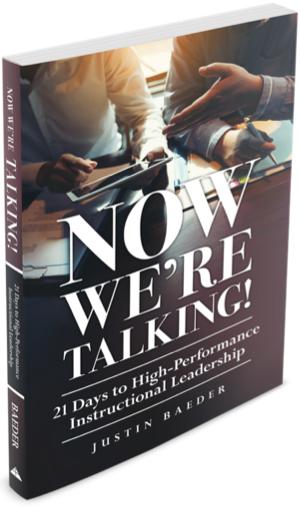
Solution Tree Press · 2018
Now We’re Talking! 21 Days to High-Performance Instructional Leadership
Build the daily habit of getting into classrooms and having substantive conversations with teachers — in just 21 school days.
Most principals say instructional leadership is their top priority — but research shows they spend just 5.4% of their time on classroom visits and 0.5% on coaching. That’s less than 10 hours per year with any individual teacher.
Now We’re Talking! is a 21-school-day implementation guide for closing that gap. Based on the 21-Day Instructional Leadership Challenge — which has engaged over 15,000 leaders from 50+ countries — this book walks you through building a consistent, sustainable habit of visiting classrooms and having the evidence-based conversations that actually improve teaching.
The 7 Characteristics of High-Performance Visits
Not all classroom visits are equal. High-performance visits share seven qualities that make them worth doing — and worth sustaining:
- 1Frequent — approximately 18 biweekly visits per teacher per year; about 3 visits per day
- 2Brief — 5 to 15 minutes per visit
- 3Substantive — focused on teaching and learning, not compliance or appearances
- 4Open-ended — treating the teacher as the expert, not narrowly collecting predetermined data
- 5Evidence-based — using low-inference descriptive notes as the basis for conversation
- 6Criterion-referenced — linked to a shared instructional framework, not personal opinion
- 7Conversation-oriented — designed to lead to rich post-visit conversations that teachers value
What’s Inside
High-Performance Instructional Leadership
Day 1 — Understanding Why Instructional Leaders Belong in Classrooms
Decisional information; three reasons to visit: better decisions, stronger relationships, enhanced professional development
- The three reasons principals need to be in classrooms — and why “checking on teachers” isn’t one of them
- Why the most important information for running your school can only be found in one place
- How classroom visits strengthen professional relationships in a way that hallway conversations never will
Day 2 — Following the High-Performance Instructional Leadership Model
Introduction to all 7 characteristics; what separates high-performance visits from check-the-box walkthroughs
- Seven characteristics that separate high-performance classroom visits from traditional walkthroughs
- Why visiting each teacher roughly 18 times a year is both ambitious and achievable — with a specific daily target
- The role of a “third participant” in every post-visit conversation that keeps the focus on growth instead of judgment
Day 3 — Acknowledging Related Models
How this approach compares to formal observations, mini-observations, data-collection walkthroughs, coaching, and learning walks
- Why the most common walkthrough models quietly train teachers to perform rather than improve
- The sampling problem that makes most classroom observation data scientifically meaningless
- The feedback paradox: why giving more suggestions can actually slow teacher growth
Day 4 — Conducting Your First Two Cycles of Visits
Planning a realistic schedule; the success rate formula; trust-building in Cycle 1, evidence-based focus in Cycle 2
- Why your first full cycle of visits should involve zero notes, zero feedback, and zero agenda
- A simple formula that accounts for the reality that half your scheduled visits will get interrupted
- The reason you should visit entire teams back-to-back — and what it signals to your staff
Day 5 — Thinking Ahead to Your Third Cycle
Low-inference note-taking; the “broken questions” technique; linking to your instructional framework
- The note-sharing practice that eliminates teachers’ fear of “secret dossiers”
- A questioning technique that invites deep reflection by saying less, not more
- What changes in your understanding of your school after visiting every classroom three times
High-Performance Habits
Day 6 — Making Time to Visit Classrooms
Parkinson’s Law; reducing emergency interruptions; scheduling short blocks throughout the day
- The scheduling law that explains why you’ll never “find” time for classroom visits — and the formula that creates it
- Why scheduling six blocks to complete three visits isn’t pessimism — it’s the math of a principal’s day
- The one conversation with your staff that can cut your “emergency” interruptions in half
Day 7 — Keeping Your Communication Channels Under Control
Staying current vs. staying caught up; inbox-based vs. stream-based media; the Delete/Complete/Delegate/Defer system
- The difference between “staying caught up” and “staying current” — and why only one of them matters
- Why some of your most-used communication tools are silently sabotaging your productivity
- A four-word processing system that can empty your inbox every day without working late
Day 8 — Managing the Work You’re Not Doing Yet
Separating planning from doing; electronic task management; capture, triage, organize, schedule
- Why the anxiety of not knowing what’s waiting for you keeps you chained to your desk
- The mental trick of separating planning from doing — and why it frees you to leave the office
- How keeping your task list under ten items prevents decision paralysis without dropping balls
Day 9 — Organizing Your To-Do List
The PEEP approach; organizing by due date, time required, energy level, and context
- A four-letter organizing principle that puts every task in its place without a complicated system
- Why organizing by action beats organizing by category — and how to set it up in minutes
- The due-date discipline that makes the difference between a trusted system and a guilt-inducing list
Day 10 — Maximizing Your Mental Energy With Habits
The habit loop; ego depletion research; five strategies for conserving mental energy throughout the day
- Why over 40% of what you do each day requires almost no conscious thought — and how to make that work for you
- The brain science behind why processing email first thing in the morning drains the energy you need most
- How to replace an unproductive afternoon habit with classroom visits by hijacking the same reward
High-Impact Instructional Conversations
Day 11 — Going Beyond Data Collection and the Feedback Sandwich
Why data collection undermines professional conversations; what’s wrong with compliment-suggestion-compliment
- Why counting specific teaching behaviors during walkthroughs does more harm than good
- The three hidden problems with the classic compliment-suggestion-compliment approach
- What teachers actually want from their principal after a classroom visit — and it’s not advice
Day 12 — Facilitating Evidence-Based Conversations
Asking genuine (not leading) questions; grounding conversation in specific evidence; sample question stems
- Five question stems that open genuine professional dialogue instead of triggering defensiveness
- Why the best post-visit conversations treat the teacher — not the principal — as the expert
- The critical difference between a leading question and a genuine one, and why teachers can always tell
Day 13 — Bringing a Shared Instructional Framework Into the Conversation
Framework as arbiter rather than opinion; grain size; broken questions for teacher reflection
- Why opinion-based conversations about teaching inevitably become judge vs. defendant
- The concept that determines whether you have enough information to evaluate what you saw — and principals get it wrong constantly
- How a shared framework lets you discuss teaching quality without personally passing judgment
Day 14 — Developing Skills for High-Impact Conversations
Making conversations professionally rewarding; listening when teachers ask for feedback; managing defensiveness
- Why the most productive conversations often end without action items or clear conclusions
- The reason you can pursue compliance or growth in a conversation, but never both at the same time
- What to do when a teacher’s self-assessment doesn’t match what you observed — and why forcing the issue backfires
Day 15 — Handling the Toughest Conversations
Responding to resistance; discouraging dog-and-pony shows; keeping conversations on instructional track
- What to say when a teacher makes it clear you’re not welcome in their classroom
- The well-meaning principal behavior that accidentally trains teachers to put on a show every time you walk in
- How framework language keeps a difficult conversation on track when a teacher tries to shift blame
Day 16 — Building Your Feedback Repertoire
Types and timing of feedback; matching feedback approach to teacher readiness
- Why reusing your best phrases across teachers isn’t lazy — it’s how you scale quality feedback
- A writing template that makes post-visit emails feel personal while taking a fraction of the time
- The professional development move that earns instant credibility: learning to speak your teachers’ curricular language
High-Performance Systems
Day 17 — Balancing Your Formal Evaluation Responsibilities
Integrating walkthroughs with formal evaluation; documentation strategies
- The 80/20 rule applied to teacher evaluation — and why equal time for every teacher is a mistake
- Why waiting until year-end to form your evaluation judgment is intellectually dishonest and wastes student learning time
- A writing format that makes high-stakes evaluation documents clear, evidence-based, and difficult to dispute
Day 18 — Identifying Improvements From Classroom Visits
Spotting patterns across classrooms; moving from individual feedback to school-wide improvement
- The research on relational trust that explains why being in classrooms builds loyalty — and being absent breeds suspicion
- Why the information you gain from frequent visits is something no one else in your school possesses
- How consistent classroom presence fills a trust vacuum that teachers otherwise fill with assumptions
Day 19 — Opening the Door to New Models of Professional Learning
Using visit data to inform PD; moving beyond one-size-fits-all professional development
- A memorable phrase that captures what too many schools actually are — and why classroom visits break the pattern
- Why video-based peer observation is less threatening than in-person visits, and how to introduce it
- The subtle shift that makes public celebration about learning rather than teacher performance — and why the distinction matters
Day 20 — Choosing an Instructional Focus for an Observation Cycle
Selecting focus areas based on evidence; aligning with school improvement goals
- Three qualities every observation focus must have — and why most schools get at least one wrong
- Why hunting for a specific teaching strategy during brief visits gives you only a 20% chance of seeing it
- The common evaluation trap of judging every question by its level on Bloom’s taxonomy
Day 21 — Scaling Classroom Visits Across Your School and District
Building capacity beyond one leader; district-wide implementation strategies
- The two-word leadership principle that does more to spread the practice than any policy mandate
- Why the assistant principal in charge of discipline may have the most to gain from daily classroom visits
- The oversight mistake district leaders make when they assume classroom visits are happening just because principals say they are
Related Episodes — Principal Center Radio
Explore Related Topics
The daily habit at the heart of instructional leadership
Evidence-Based FeedbackConversations that treat teachers as professionals
Personal ProductivityManaging your workload so you can lead instruction
Habit FormationThe science of building sustainable leadership habits
Teacher EvaluationMaking evaluations evidence-driven and growth-oriented
Instructional FrameworksShared language for talking about teaching
About the Author
Justin Baeder, PhD is Director of The Principal Center, where he helps senior leaders in K-12 organizations build capacity for instructional leadership. A former principal in Seattle Public Schools, he is the creator of the Instructional Leadership Challenge, which has helped more than 15,000 school leaders in 50 countries around the world:
- Confidently get into classrooms every day
- Have feedback conversations that change teacher practice
- Discover their best opportunities for school improvement
Dr. Baeder directs the Instructional Leadership Association, the premiere professional membership for school leaders, and is the author of three Solution Tree books on instructional leadership:
- Now We’re Talking! 21 Days to High-Performance Instructional Leadership
- Mapping Professional Practice: How to Develop Instructional Frameworks to Support Teacher Growth (with Heather Bell-Williams)
- Cultivate and Activate: Building Teacher Capacity for Instructional Leadership (with Keith Fickel)
Justin is the host of Principal Center Radio, a long-running audio podcast featuring more than 400 education thought leaders and more than 500 books, as well as The Teaching Show and The Eduleadership Show. A prolific education commentator, he has more than 250,000 followers and 30,000,000 annual impressions on social media, and is frequently consulted by major media outlets on issues of education research, policy, and practice.
As a consultant, trainer, and speaker, Dr. Baeder has worked onsite with groups across the US, Canada, and Central America, and virtually with groups across the Middle East, Australia, and around the world. He is a frequent speaker at conferences, and regularly provides administrator professional development on classroom walkthroughs, teacher evaluation, and instructional leadership.
He holds a PhD in Educational Leadership & Policy Studies from the University of Washington and an MEd in Curriculum & Instruction from Seattle University, and is a graduate of the Danforth Program for Educational Leadership at UW.
Keep Building After Day 21
ILA members get weekly video episodes, on-demand courses, and the full Ascend career toolkit — including AI coaching to keep developing as instructional leaders.
Start Your Free Trial →