[00:01] Justin Baeder:
Welcome to Principal Center Radio, bringing you the best in professional practice.
[00:06] Announcer:
Here's your host, director of the Principal Center and champion of high-performance instructional leadership, Justin Baeder. Welcome, everyone, to Principal Center Radio.
[00:15] Jon Saphier:
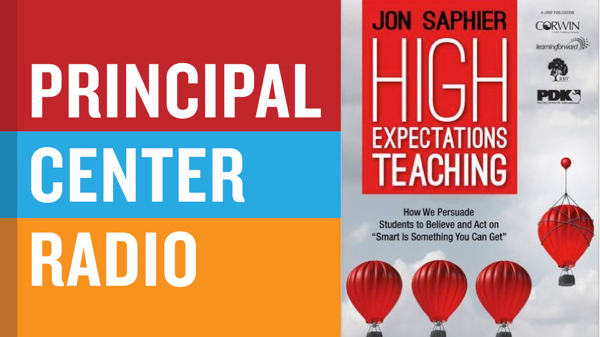
I'm your host, Justin Baeder, and I'm honored to be joined today by Dr. John Safier. Dr. Saffier is the founder and president of Research for Better Teaching and is the legendary author of eight books, including The Skillful Teacher, which has sold more than half a million copies and is used in teacher education programs around the world. And we're here today to talk about his new book, High Expectations Teaching, how we persuade students to believe and act on smart is something you can get.
[00:44] Announcer:
And now, our feature presentation.
[00:46] Jon Saphier:
Dr. Safier, welcome to Principal Center Radio.
[00:48] Jon Saphier:
Thank you, Justin. Glad to be with you.
[00:49] Jon Saphier:
I wonder if we could start by talking about the problem that you saw in our profession, in the work that we do with students, that this book, High Expectations Teaching, is designed to address. What did you see happening in schools that needed to be addressed?
[01:04] Jon Saphier:
Well, all of us as teachers and also as leaders have had kids who don't believe in themselves, kids who won't do their work or come to school regularly. late or who skip classes and Who may get into trouble a lot as a way of being visible or may withdraw put the hoodies up? Intempt to be silent and not seen these are kids who don't believe anymore that they have academic ability and have given up on themselves and given up on school and what I realized as the years rolled on is that we really have the tools to to get these kids who are falling father and father behind with each passing year to adopt the growth mindset, or as my friend Jeff Howard said 30 years ago, to start believing that smart is something you can get, not something that you are or are not.
[01:58]
So it was to give us the tools and the confidence and the belief ourselves as teachers to reach these kids just in the It was the origin of this book.
[02:08] Jon Saphier:
I remember my mentor, John Moorfield, teaching principals and teaching students to really internalize and believe that. And they would say in assemblies, you know, I'm smart, I'm very smart, and the harder I work, the smarter I get. And this was years before Carol Dweck's work on mindset became widely known. But this idea that intelligence is malleable, that it's not, that we have some kids who are smart and good for them, and then We have me and everybody else who are kind of destined to not succeed in school, but really that this is something that can be shaped, that can be built, and that it's really our responsibility as educators to cultivate that mindset in all of our students.
[02:46] Jon Saphier:
Exactly. You know, the idea that intelligence can be grown goes all the way back to Alfred Bernays, who was the first person ever to write what is now called the intelligence test. Let me read you a couple of quotes from him. These are in the first two chapters of the high expectation teaching book. Here's Bennett talking about his own test. The scores are a practical device.
[03:09]
They do not buttress any theory of intellect. They do not define anything innate or permanent. We may not measure or designate anything that the test measures as intelligence. Here's another one. The scale is a rough empirical guide for identifying mildly retarded and learning disabled children who need special help. It is not a device for ranking normal children.
[03:32]
It's the guy who invented the test. Here's one more. Intelligence is subject to development. Just what you were saying, Justin, about what Mr. Warfield said to you. But with practice and training and especially appropriate methods of teaching, we can augment a child's attention, memory, judgment, help him literally to become more intelligent than he was before.
[03:54]
And then the last line, this particular quote, by the way, was in one of Seymour Saracen's book, The Culture of School and the Problem of Change. These children should especially be taught to will, you know, desire, ganas, to will with more intensity, to will that is indeed the key to all education. So what I tried to do in the first two chapters of the book was give the history of how it is that the bell curve belief got to be so strong in this country. In fact, stronger than any other country in the world. It's not like we're the only place, but it's stronger here. And then to give the contrary evidence, which is quite sound and widespread, that the bell curve is not true.
[04:36]
And that is because before we as teachers can begin to act as if we believe all children, really all children can learn, we have to confront our own beliefs about this bell curve, which you inhale if you grow up in this country. So yes, indeed, that's the foundation of it all.
[04:54] Jon Saphier:
And what do you see as some of the key things that we tend to do as educators that reinforce that bell curve belief that there are a few students who are smart and most people are kind of average and a lot of students just don't have much chance? What are some of the subtle things that we do just on a regular basis all the time in education that reinforce that belief in ourself and in our students?
[05:15] Jon Saphier:
Well, the first place it shows up, Justin, is in our verbal behavior and what we say to kids and to whom we say it. The origin of this in 1968 was the Rosenthal and Jacobson study called Pygmalion in the Classroom. Does that ring a bell with you? And I wonder if it does with our listeners. What they showed is if you give phony IQ scores to teachers, which randomly assigns some kid a number that makes you think they're bright, you'll act differently towards them. And they had 13 behaviors in a list.
[05:49]
that we do. You smile and nod more towards the kids you think are capable. You use wait time more. You ask them more higher level questions. You ask them more questions, period. Other subtle forms of messaging, which kids pick up just brilliantly, is the words we use when we give help.
[06:13]
A kid says, Mr. Saffrey, Mr. Saffrey, can you give me some help? And I got some scripts in the book that show the subtle differences in language which have embedded messages in it. You know, a kid says, I can't do this. A person with confidence in a kid might say, oh, well, what part can't you do?
[06:29]
Because you did the first three correctly. And somebody who doesn't believe in kids might say, you can't? Why not? You know, like, What a no-win question that is. If the kid knew why he couldn't do it, he wouldn't be able to do it. So there are these situations that occur every day, hundreds of times, where the subtleties of the language have embedded message.
[06:49]
Another one is if I'm going to reteach something to a group of kids, what do I say as I reteach it that expresses to them my belief they're able, and this is going to get them over the hump, as opposed to some embedded message that they are less than or remedial. There's a great videotape I have of a teacher from Illinois, Evanston Township High School named Zach Herman. And he introduces a reteaching segment by saying, wow, here's my favorite part. This is where everybody gets what they need. And if you listen to the rest of the dialogue, you see those kids are getting belief in them channeled their way. So that's one place.
[07:31]
There are about 10 situations like that where it's worth examining our behavior. Another one is what structures are set up in the room because of the very structures and the routines we have for doing such things as taking quizzes. Do you get to grade it yourself and do error analysis or do I grade it and just put it in the book? Structures that have to do with quizzes, error analysis, student self-correction. How do you get extra help? These structures have embedded messages in them too.
[08:04]
And I think there are many other blatant structures that are school-wide, like how do kids get placed in special ed? Who's getting discipline referrals and getting suspensions? What is the way in which kids are tracked? The very existence of tracking has embedded messages in it. So what I did in the book is I broke out six categories like this and tried to go into detail about what it looks like and sounds like. when one is trying to send positive messages to kids.
[08:34]
instead of inadvertently saying negative ones.
[08:37] Jon Saphier:
Right. And those positive messages are not just, you know, motivational posters, not just you can do it, not just pat on the back encouragement, but you're actually trying to help students develop a sense of agency, a sense that they not just can repeat the motivational phrase or that they persist when we tell them they can persist, but internally that they have this sense that they really are capable and that their effort really is worth expending.
[09:02] Jon Saphier:
Well, I can see you read some sections of the book, Justin, because that's one of the main points I'm trying to make. I think a superficial view of Carol Dweck's work is if I teach the kids that the growth mindset exists and show them the videos and put up the posters and keep encouraging them, it's going to make a difference. Well, it might make a difference for some kids, but that's just the beginning. We have to actually show by our behavior that we believe about them. I think that Carol's book was a breakthrough because she wrote in a readable fashion what people in the voting public have taken an interest in. As you mentioned before, these ideas go way back, not just to Binet, but researchers in the 50s like Albert Bandura, Jerome Wiener, Jeff Howard was a pivotal figure, and all of these
[09:54]
uh, we're conveying this message and it never really took off until Carol wrote the book that everybody could read after 30 years of research and articles that only researchers read. So I am hopeful that we can now make a real dent in teacher ed and in, in our own practices and examine how we embed these messages.
[10:14] Jon Saphier:
Well, let's talk just about one or two more examples of some of those practices that can very quickly be changed. I think as educators, we almost universally believe everything you've said, but we simply don't practice on a day-to-day basis those behaviors that we know make a difference. So what's an example of a practice that teachers can adopt pretty quickly that doesn't require a fundamental rethinking of their philosophy of education or their approach to instruction, but that really does make a difference In building that mindset in students, building that sense of student agency compared to typical practice.
[10:49] Jon Saphier:
Right. Well, I think that the structure of quizzes is an easy one to modify. In fact, it takes a little work off the table, except that I want to give a quiz to kids every week. It doesn't have to be long, but then I want them to self-correct it. And you don't run into problems of honesty here if you just use a few simple devices like having the kids corrected with another pen you pass out. That's a different color.
[11:16]
But I want the kids to record the results themselves so they can see cumulative progress over time. And when they self-correct their own quizzes, I want them to correct whatever errors they realize they made by working with a partner right then and there. One can do that for homework as well. I want to signal that what is recognized in this room is not getting it the first and getting it fastest. It's that you understood your errors and you were able to correct them. That's the sign of a good student.
[11:48]
The other things that are not philosophically based are things like the pattern of calling on kids and whether or not you ask them higher level questions. We always used to do an experiment in our courses where our participants had to take the material originally developed by Sam Kerman 40 years ago. He translated the Rosenthal and Jacobson findings into a PD program for teachers called TESA, teacher expectations, student achievement. And we use that list of things that people tend to do like call on certain kids more, smile and nod more as a observation checklist and peers would observe each other to see with which kids and how often the following behaviors were rolled out. And it was often shocking to see the results because if you ask me, do I treat all kids equally fairly?
[12:40]
I would say, of course I do. Except that when I would see the results of this, it would become obvious to many of us that we were not as, as egalitarian in the way we asked higher level questions as we thought, or smiled and nod, call on kids, et cetera. Now, another thing that it is easy to change if you simply decide to do it, and that is students who are behind academically in reading and writing are perfectly capable of higher level thinking, even though the reading material they are able to do with fluency may be several grade levels below what their actual chronological grade level is. So the practice is to conduct discussions based on higher level questions about things that we have read. It could be nonfiction, it could be fiction, but simply planning questions that will elicit different points of view and then involving everybody in the discussion will generate interest in students who are behind, that school is actually a place where they're encouraged to think.
[13:44]
Now, there is a practice that's not so easy to adopt. It used to be called accountable talk. Now it's called making students think invisible. And these are ways of, of supporting robust dialogue amongst students. And what's not easy about it to do is that I have to stop talking so much as the teacher. I have to give up being the sage on the stage and investigate what I have to do to get the kids interacting and talking with one another.
[14:12]
Anyway, those are a few of the practices. that I would recommend people dive into right away.
[14:18] Jon Saphier:
Yeah. Well, I should say the book is loaded with tons more very, very practical, very, very straightforward and familiar to our ears, but not necessarily something we're doing across the board. I think in large part because we don't always see the connection between those choices that we make instructionally, between how we call on students, how we grade quizzes, how we do these various things that we do every day. Students perceptions of their own intelligence students sense of agency So thinking at the the school level stepping back from from what we're doing in individual classrooms What do you see as some of the the key pieces for school leaders to put in place? System wide or school wide to ensure that these practices are thought through you know that we don't just teach the way we were taught that we don't just revert to kind of traditional thinking about intelligence and and kind of slip away from these practices that we know make such a difference for our students?
[15:12] Jon Saphier:
Well, a key one is hiring teachers who believe in the growth mindset. Now, that's easier said than done, because if I ask a candidate, do you believe in the growth mindset? And they say, yes. Obviously, I'm going to follow up and say, well, would you tell me why? There are folks who have maybe read the book or Carol's book and can talk the game. But you can't find out if they mean it until you ask them what would you do if questions.
[15:39]
How do you handle kids who routinely don't do homework from a growth mindset point of view. What do you do to get the kids to believe themselves that they can grow their ability. What have you done in the past that you could show as evidence that you acted in this way in your own life. Another thing would be as many school leaders do observe the person teach before you hire them and especially Listen in on the conversations that a teacher has at the door as kids are coming through. That's at the beginning of the day. If it's elementary, it's the beginning of the period and secondary.
[16:14]
And listen in when they walk around the class and look over kids' shoulders and respond to requests for help. Listen for the embedded messages because you won't be able to cover that up if you don't really act from a heart of, believing that kids are capable and wanting them to. The other thing that I think school leaders could do is look at the reward system of the school. What is a championship student? What gets rewarded here? Do we go beyond an honor roll and say, we're going to go out of our way to recognize kids who made progress?
[16:49]
Big progress, moderate progress, but progress. Progress is what gets rewarded rather than starting out at just at a high level of performance. Also, there is a strong relationship between a classroom climate of support for students in a classroom or in a school. In other words, as kids, we we have a stake in other kids success. That's the way the climate's been created. If I there's a connection between that climate and kids exerting effective effort.
[17:21]
So at the school level, I'd want to know if there's been attention to developing climate and linking the two. And finally, I would want to know at the school level whether we have made effective effort a theme. Effective effort has very specific attributes. It includes knowing how to focus and eliminate distractions. It includes knowing how to get help when you need it. It includes trying other strategies if the first one didn't work.
[17:49]
And these these one can explicitly teach the kids. So I want to know at the school level if there has been a study group around what effective effort is and if we all take it on as something that we're going to share this language. And it's sort of an umbrella curriculum that we all teach.
[18:08] Jon Saphier:
Well, what are some good starting points for school leaders who have been tracking with us, who are on board? What are some first steps that we can take to get started school-wide?
[18:17] Jon Saphier:
Well, I think the first steps are readings in common and discussions with the faculty, book studies, articles. But the other thing is, if I want this work to begin and take off and to stick, I have to be perseverant about it. No single faculty book study of high expectation teaching is going to do it by itself. So the next thing I would do is I would try and identify a few teacher champions who are really interested in modifying their own practices. And I would make a study group out of those four or five people and say, let's observe each other. I'm going to try it too.
[18:54]
Modeling in my behavior as a school leader, how I would interact with kids if I were doing it from the growth mindset. The word will spread and that will send a powerful message throughout the school. Not only that I'm doing it, but that I'm a learner about it and that I don't expect myself or my colleagues to be perfect at it. And I would use that study group as a opportunity for us to videotape ourselves, to open the doors for others to come in and watch what we're trying. If there are any courses on applying the growth mindset in our area, I'd send the champions and anybody else who wanted to come into it. So I want to build a head of steam and a belief that this is possible.
[19:35]
And what finally puts it over is when there are case studies of kids who systematically underperformed for years. And one or two of us decided to focus on getting this kid to believe in themselves. And all of a sudden they come out of their shell. And it may take more than one year. But in our courses, we always have people pick a kid. who is underperforming and lacks confidence, make a case study out of them.
[20:02]
And I would say the majority, I'm sure the majority of those case studies within one year get breakthrough results for those picked kids. And that's even, even the teacher who was doing the case study may not have believed it was going to work, but they have to do it because it's an assignment. And then when it works, They say, holy mackerel, how come I just did this for one kid? I could have been doing this for a whole bunch of them. So there's a progression of things there, Justin. that I recommend with school leaders.
[20:32]
Patience and persistence underlying everything.
[20:35] Jon Saphier:
Fabulous. Well, I love that kind of pilot or establish a beachhead approach and the modeling on the school leader's part and choosing a student to focus on transforming their mindset and helping them develop that sense of agency and believe in themselves. John, if people want to learn more about your work at Research for Better Teaching and the training and professional development that your organization provides, where's the best place for them to connect with you online?
[20:58] Jon Saphier:
I would say rbteach.com. Our website describes almost all the things we do and there's a connection to blog there. But most useful might be we have 50 different videos that we've made in our library that illustrate people doing these things. And that's accessible on the website under the, let's see, the header that says products and resources. There's a lot of they're all for free and a lot of documents downloadable for free, too.
[21:28] Jon Saphier:
Thank you so much for joining me on Principal Center Radio. It's been a pleasure.
[21:31] Jon Saphier:
And my pleasure, Justin. All the best to you and to your listeners.
[21:35] Justin Baeder:
And now, Justin Baeder on high performance instructional leadership.
[21:40] Jon Saphier:
So high-performance instructional leaders, what did you take away from my conversation with Dr. Saffier? Wow, that was a fun one for me, the chance to speak with just a legend and a giant in our field who's worked as a researcher, who's worked as a professional developer, as a school leader, and has really dedicated himself and his career to building that growth mindset that we've been talking about, for a long time now in education, but to actually see how it's happening on the ground, how schools are building that mindset in students, I think is so powerful. And I want to encourage you to go to Dr. Saffier's website, rbteach.com, and check out the video library that he mentioned.
[22:19]
There are some terrific videos there where you can see professional learning communities in action. You can see sample clips of teaching. And on this podcast, I don't often recommend a book for whole faculty book studies, but I want to encourage you to check out High Expectations Teaching. The full title, again, is High Expectations Teaching, How We Persuade Students to Believe and Act On Smart is Something You Can Get. So take a look at that, get a copy for yourself, and see if this is a good book for you to focus on in an upcoming, maybe a year-long, whole faculty book study.
[22:53] Announcer:
Thanks for listening to Principal Center Radio. For more great episodes, subscribe on our website at principalcenter.com slash radio.