[00:01] Justin Baeder:
Welcome to Principal Center Radio, bringing you the best in professional practice.
[00:06] Announcer:
Here's your host, Director of the Principal Center and Champion of High Performance Instructional Leadership, Justin Baeder. Welcome everyone to Principal Center Radio.
[00:15] Erik Francis:
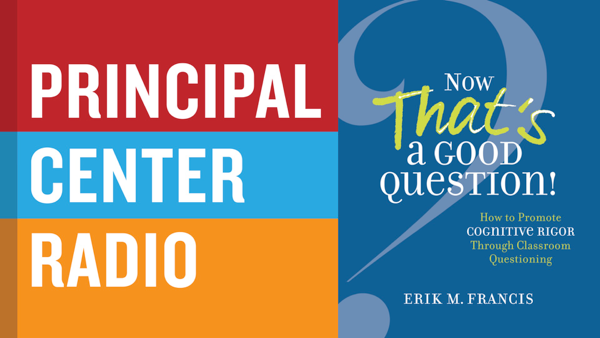
I'm your host, Justin Baeder, and I'm honored to be joined today by Eric Francis of Maverick Education. Mr. Francis is a professional development consultant specializing in helping schools provide instruction that challenges students to demonstrate higher order thinking and communicate their depth of knowledge. He's worked as a middle and high school teacher, a site administrator, and an education program specialist at the Arizona Department of Education. And he's the author of the ASCD book, Now That's a Good Question, How to Promote Cognitive Rigor Through Classroom Questioning.
[00:48] Announcer:
And now, our feature presentation.
[00:50] Erik Francis:
Eric, welcome to Principal Center Radio.
[00:51] Erik Francis:
Thank you. It's a pleasure to be here. It's an honor to be here as well.
[00:54] Erik Francis:
Well, I wonder if we could start by talking about rigor. It's one of those kind of dangerous topics that everyone has heard of. Everyone thinks they know what it means. I think I know what rigor means. But I think I should probably ask you, what does rigor mean? What does rigor actually look like?
[01:09]
I know you do a lot of work with schools around web's depth of knowledge and questioning. So as kind of a starting point, what is your definition of rigor?
[01:17] Erik Francis:
Well, I look in terms of the definition of cognitive rigor that was developed by Karen Hess and John Walkup and Ben Jones and Dennis Carlock. And cognitive rigor, what that does, it superimposes Bloom's revised taxonomy, which identifies the type of thinking that students are supposed to demonstrate, with Webb's depth of knowledge, which is the depth and extent of learning that students are supposed to communicate. My definition of rigor, as I define it, is that we challenge, engage, encourage students to think deeply about and express and share the depth and extent of their learning insightfully and in their own unique way. So the rigor is a balance of thinking and knowledge, but also the context in which that thinking and knowledge is transferred and used.
[02:04] Erik Francis:
And it's one of those things that, of course, everyone thinks they do. So in your work with schools, what are some of the manifestations that you see of kind of attempts at rigor that fall short? What are some of the things that we do in an attempt to be rigorous, in an attempt to provide rigorous instruction that kind of fall short of that definition? What does that look like?
[02:24] Erik Francis:
Well, the unfortunate thing is that we have that traditional definition of rigor. And if you looked it up, basically... It sounds like the kind of educational experience, a learning environment you're supposed to develop and deliver. Sounds more like the teacher from Pink Floyd's Another Brick in the Wall Part Two or even Professor Snape.
[02:41]
It's not about difficulty. Difficulty is an aspect of it. But when we talk about difficulty with rigor, it's about students working hard to put in the time and effort to do their work. Now, that increase in difficulty is not about giving students more to do, more pages to read, more problems to solve, or more tasks to complete. It's about pushing them to go further, to go deeper. That's where the difficulty lies, where you go ahead and dedicate the time and effort to go deeper with the learning.
[03:14]
But rigor is also about complexity, complexity in thinking, complexity in terms of the context in which you transfer and use what you've learned. So in a nutshell, when it comes to rigor, it's basically how far you take the learning. So you have the first aspect of rigor, which is about acquiring and gathering the knowledge and information, learning about the text and topic, getting that background knowledge. The second part of rigor would be using that knowledge to answer questions, to address problems, to accomplish tasks, to analyze texts and topics. The third level would be Why can I use that knowledge to attain and explain answers, outcomes, and results? So you're kind of doing a backward thinking when you come to this, an investigation, taking apart the problem, the question, the task, the topic or text, and putting it back together.
[04:04]
And then the fourth aspect is going deep within the subject area to find those connections or across the curriculum beyond the classrooms. That's what true rigor is. How can we challenge, engage, and encourage our students to think deeply and also express and share the depth and extent that they're learning in different academic and real world contexts?
[04:25] Erik Francis:
And you said you're kind of crosswalking Bloom's taxonomy with Webb's depth of knowledge?
[04:30] Erik Francis:
Correct. And that's what Karen Hess and John Walkup and Ben Jones and Dennis Carlock came up with. That's how they created this idea of cognitive rigor. So Bloom's taxonomy is what we traditionally use, of course, in education. When it comes to cognitive rigor, we should use the revised version that Anderson and Crothwell did, which is focused on the verb. So the verb tells us what's the level of thinking, what's the type of thinking students are expected to demonstrate.
[04:55]
The depth of knowledge comes after the verb when it comes to a performance objective. So if I said analyze how multiplication problems can be represented and solved, in different academic and real-world contexts, that's the depth of knowledge. So it's the subject matter and specifics in which students will be demonstrating, communicating their learning. So when they designed it, they superimposed Bloom's revised taxonomy with depth of knowledge. It's not the same thing, and that's a strong misconception. Bloom's taxonomy is about the cognition, the thinking.
[05:30]
Depth of knowledge is about the context, the abstractness of the scenario, or situation or setting in which that thinking knowledge will be demonstrated. So when you have that, what you've done is you've created a deeper and more extensive learning experience for the student. So we go from explaining, for example, what is multiplication, defining it, describing it, describing the procedures, using it to answer multiplication problems, to explaining how can multiplication be used, how can the concept and procedures be used to solve a problem, to giving students products, the actual answers, and saying why can multiplication be used to verify whether this problem is correct or incorrect. And then DLK4 is more doing a more extensive investigation.
[06:22]
How else could multiplication be used? how can you perform multiple steps to use multiplication in different academic and real world contexts.
[06:31] Erik Francis:
So it sounds like it's a lot more specific than simply saying, I want to ask my students questions that really make them think. You're actually getting into the level of abstraction of their thinking and the context in which it applies, as well as the specific cognitive task that you're asking them to engage in. This is something Dr. Amy Baeder, my better half, often says when she's working with teachers on questioning is that you can't simply wing that type of question. Have you found that to be true in your work with teachers?
[07:01] Erik Francis:
It's very challenging when it comes to developing questions, and it's something that's basically becoming not only an instructional shift, but basically a growth mindset when it comes to questioning. We traditionally use questions to assess knowledge. We traditionally use questions to assess thinking. It's been very outcomes-based. What I'm proposing with the questioning is how can we use questions to set the instructional focus, to get the kids thinking, to move away from being directive with educational objectives or directions to do something, to asking them to think critically and creatively and reflectively and even relevantly How can they use what they've learned to answer a question, address a problem, accomplish a task, or analyze a text and topic? The real struggle that many teachers I'm seeing having with questioning is,
[07:54]
Really coming up with how to create that really strong question that will just really set the instructional focus for an entire learning experience. And there's also a lot of confusions about questioning. I mean, I say good question, but that's not about what is a good question, what is a bad question? A good question, I say, it stimulates deeper thinking. It deepens knowledge, understanding, and awareness. It expands knowledge and extends thinking.
[08:21]
It piques curiosity, imagination, interest, and wonder. And more importantly, it allows a student to express and share the depth and extent of their learning. So it really creates a strong purpose for learning for students.
[08:35] Erik Francis:
Wow, that's so different from what you contrasted that to earlier with our kind of traditional use of questioning as a means of assessment, a means of kind of seeing if students are getting it, seeing where they are. But you're saying it's really much more about kind of pushing students into the depth of the learning itself, not just looking back and assessing.
[08:55] Erik Francis:
Right, right, because what happens is if you look at test assessments, they're not even written as questions. They'll give you a situation or maybe say, which one is this or what is the answer? I mean, that's a very, very low-level question. The thinking may be high, but it's more of a low-level question because you're asking basically most likely to identify, and that's with a multiple-choice question. And it's really interesting because if you look at assessments, they're all very directive. Write an essay, analyze the topic, interpret the problems.
[09:25]
It's all very directive. We need to use questions to stimulate thinking. We need to get questions to really get the kids to think about what it is that they're learning. Why is this important to learn? How can I use this? And more importantly, what else can I do with this?
[09:41]
In my work, I have actually found that's really worked well with what we consider to be low-level readers or struggling students because our struggling students, they have a difficult time remembering and understanding. But they want to know, how does it work? Application. Why does it work? Analysis. What impact or influence does it have?
[10:03]
That's evaluation. What else can I do with it? That's create. Giving them questions that really stimulate their thinking, really get them to think deeply about what it is that they're learning. And not so much even just focusing on that one item that they're given, but more so saying, this is the concept, this is the procedure. You can use this and think about critically and creatively, how could you use this to answer any kind of question like this or address any problem like this or accomplish any task like this given any kind of context.
[10:35] Erik Francis:
So Eric, I understand you go through eight types of questions in the book, starting with essential questions. And I wonder if you could walk us through those real quick.
[10:43] Erik Francis:
Right. Well, with the eight types of questions, again, I identify eight types of questions that really get the kids to scaffold their thinking. It goes more so from setting the instructional focus to developing the deeper knowledge and understanding in a concept procedure to even extending thinking to think creatively and personalization. The first set of questions I talk about are essential questions. And when it comes to essential questions, there really has not been really a clear definition. If you look at Jay McTighe and Grant Wiggins, they'll say it's the most important questions to address in life.
[11:17]
And if you look at Ted Sizer, it says the most important questions in his subject area. And John Larmer will say it's the question that sets forth for a project-based learning experience. So what I did in the book is I identified four types of essential questions. The first type I call universal questions. Those are like your meaning of life questions. In English language arts, those would be the thematic questions.
[11:36]
So an example of a universal question would be, what is life? An overarching question is the core question you would ask in a subject area. You would ask that in kindergarten, you would ask that in third grade, sixth grade, ninth grade, twelfth grade, college, or way beyond your postgraduate studies into your workforce. So if it was science, I could say, how does science explain natural events and phenomena? If it was English language arts, it would be, how can the central idea and theme be determined, and how does it develop over the course of the text? This is where we get these questions from the overarching or the anchor standards or the standards or practices in college and career-ready standards.
[12:20]
The topical essential question is that one question that sets the instructional focus and serves the summit of assessment for a unit. So if I was teaching about science, I was teaching biology, I would say, what distinguishes living from non-living things? If I was teaching English language arts, maybe reading informational texts, How is life defined in a dictionary versus legally, religiously, or philosophically? The driving question is a project-based learning. This is where you would basically refer to the student as you and include you in the question, and it sets the student forward to go and create something, to design, develop, and do something. So the driving question in science would be, What kind of model could you develop and use to distinguish between living and non-living things?
[13:11]
And in English language arts would be, what kind of argument could you write and present that explains the meaning of life or definition of life from a legal standpoint versus a religious standpoint? So that's what the essential question is. It really sets the instructional focus. The other seven questions get the kids to go deeper. Factual questions require correct or incorrect responses. This is where they're building background knowledge and foundational understanding.
[13:41]
Analytical and reflective questions are the hows and whys. Analyticals would be more so dealing with analysis, dealing with categorization, classification, interpreting, inferencing, seeing what it represents or symbolizes. Reflective is about establishing what are the causes, the connections, and the consequences. Once you have that, then you're going more into critical and creative thinking. Hypothetical questions are for thinking creatively. What if?
[14:10]
What would happen? What could happen? Argumentative is when you make decisions and defend or refute them. And then you go into the last two, which I call more personalized learning. Effective questions are about emotions. What do you think?
[14:25]
How do you feel? What do you believe? How would you? How could you? And then the most powerful one is the personal question. And that's asking the kids, what do you want to learn about this text and topic that we're learning about in class?
[14:40]
So let's say I was doing, again, about living things. So I would ask the students, what do you want to learn about living things? And they would come up with their own question. And I would tell the students then, OK, you're going to go out and get your response, and then you're going to present that to the class. What that does is that it invests the students into the learning and also turns a student into a teacher who shares the information they find.
[15:03] Erik Francis:
Well, that's fabulous. So as we think about our role as instructional leaders, Eric, and as we go around to classrooms, you know, I'm really striving to get instructional leaders into classrooms 500 times this year. What are some things that we need to keep in mind? And in fact, if you could kind of wave a magic wand and get all of us, all instructional leaders, all administrators, to do something in particular when it comes to promoting cognitive rigor, to promoting good questioning, what would you have us do as instructional leaders?
[15:33] Erik Francis:
Well, the first thing I would do is advise the leaders to basically advise their teachers that whenever they ask a question or if they present information, Always follow it by asking why. If a student gives a response, ask them, what do you mean? Don't just let them off with the answer. Have them delve deeper into it. Have them explain themselves. The other thing I would advise is instead of having them post the objective on the board, have them post the question.
[16:07]
Have them post the essential question of the day or what I call the daily good question. Also, the most important thing I would advise leaders to do is ask your teachers, who's talking more in the classroom, them or the students? Who's presenting the information more in the classroom, them or the students? When I do my walkthroughs in my schools, because I also do walkthroughs and I observe for teaching and learning for cognitive rigor and give coaching and mentoring and advice to teachers and recommendations to teachers about this, I will ask the teachers, so who's presenting the information more? Who's talking more, you or the students? And more often than not, the teacher will say, well, I'm the one who's presenting the information.
[16:49]
And I will advise them or recommend, you need to flip that. You need to have the students go out and basically get that information. You need to have the students looking in their text for that information. The students need to be sharing the information more. The students are the ones who need to be basically teaching almost the classroom. I advise teachers to act like an empty vessel.
[17:11]
Tell the kids, you're going to teach me. And what I'm either going to do is affirm that you are accurate or not accurate. Or I'm going to ask you, what do you mean to elaborate further? So that's what we need to do. We need to have the kids be more active. We need to have the kids responding more actively.
[17:29]
And if they go, I don't know, or if they just go silent, have the teacher say, talk amongst yourselves. What did I just ask you? That's what I do actually in my PDs with teachers. If I ask a question, it's funny. Not a lot of people jump up and want to give an answer. So I'll notice that and I'll say, okay, now talk amongst yourselves.
[17:46]
What do you think about what I just asked here? And I'll walk the room and I'll listen. You can do that with one good question in the class. You can have that dictate the whole class. I've done this as a teacher. I've walked in and said, how did Edgar Allen Poe invent the detective mystery genre?
[18:02]
And I had my students just set forth and go out and get the information, took the whole class. And then I said, OK, last five minutes, I need you to report back to me what's going on here. And they basically shared all the information. All from one good question. And all I did was ask the question and walk the classroom.
[18:21] Erik Francis:
And that really encapsulates kind of for me the difference between an education where you're just kind of dragged through different standards and different lessons designed to help you meet those standards. You know, the education that none of us would really, you know, envy a kid who's receiving that kind of education versus the kind of almost, you know, I was thinking about dead poet society when you described that kind of intellectual climate in the classroom where kids are really being challenged to think deeply, you know, possibly ripping pages out of their textbook, possibly not. Well, We'll leave that up to the individual at school. But, you know, I'm inspired by the potential that's there to really not only increase the cognitive rigor and the engagement, but really to make school a place intellectually where students thrive and where students love to be. So thanks so much for sharing some of your strategies from the book.
[19:13]
If people want to get in touch with you, learn more about your work, Eric, where can they find you online?
[19:17] Erik Francis:
You can go to my website, which is at www.maverick, M-A-V-E-R-I-K, no C, maverickeducation.com. Or you can email me at eric, E-R-I-K, at maverick, M-A-V-E-R-I-K, education.com. And you also can find my profile on the ASCD website under authors at ASCD.org.
[19:45] Erik Francis:
Fabulous. So the book is Now That's a Good Question, How to Promote Cognitive Rigor Through Classroom Questioning. Eric, this has been a blast. Thanks so much for joining me on Principal Center Radio.
[19:55] Justin Baeder:
Thank you, Justin. Thank you for having me. And now, Justin Baeder on high-performance instructional leadership.
[20:02] Erik Francis:
So high-performance instructional leaders, what did you take away from my conversation about cognitive rigor and questioning with Eric Francis? One thing that stands out to me, as I will often say on Principal Center Radio, is that we have to get the core idea right. And I want to challenge you to look into Webb's depth of knowledge and look into the Bloom's taxonomy and look at the ways that those are being used together through the work that Eric cited in our interview and shares in the book. Now, that's a good question. It's very easy in our profession to get a secondhand report of what something is, to get a secondhand definition. One of the things I really enjoy about doing this podcast for you is going to the source, actually speaking with authors, speaking with experts, and hearing in their own words, you know, what is rigor?
[20:52]
What is a deep question? What is an essential question? Because I think there's a danger in translation. When we repeat an idea too many times, it's like a game of telephone, and we get away from what it really means and what it really looks like. So if that's been happening in your school when it comes to rigor, when it comes to questioning strategies, I want to challenge you, whether you look at Eric's book or another source. We've also spoken on Principal Center Radio with Dr. Barbara Blackburn, who is another expert on rigor.
[21:23]
I want to encourage you to go to the sources, either the original research or the kind of secondary resources like books that really do a fantastic job of defining very tightly the what these terms mean and how they can be applied in our schools. And then as you get into classrooms, I want to challenge you to press teachers on those definitions. And if we start to deviate, if we start to use words in ways that are inconsistent, words like rigor, words like terms from the depth of knowledge, if we're deviating from what those really mean and we're just kind of relabeling things that we've always done, I want to press you to challenge your teachers on that and really be rigorous and be consistent and specific in using that terminology because it's through that specificity that we get better, that we develop shared understandings, that we develop a shared vocabulary for what good instruction looks like.
[22:18]
And above all else, I want to encourage you to get into classrooms and talk with your teachers on a regular basis. I'm on a mission this year to get a million visits to classrooms that wouldn't have otherwise happened to happen thanks to the Instructional Leadership Challenge. So if you've never been through the Instructional Leadership Challenge, we've had more than 5,000 people from 50 countries around the world go through it. You can sign up for free. If you've already taken the challenge in years past or if you've gotten partway through it, if you sign up again at instructionalleadershipchallenge.com, we'll just start you over right at the beginning and you can start getting into classrooms, providing feedback to teachers, having great conversations, evidence-based conversations about instruction with teachers, and everything will start to shift in your school.
[23:00]
So check it out at instructionalleadershipchallenge.com.
[23:04] Announcer:
Thanks for listening to Principal Center Radio. For more great episodes, subscribe on our website at principalcenter.com slash radio.