
Full Transcript
[00:01] Justin Baeder:
Welcome to Principal Center Radio, bringing you the best in professional practice.
[00:06] Announcer:
Here's your host, director of the Principal Center and champion of high-performance instructional leadership, Justin Baeder. Welcome, everyone, to Principal Center Radio.
[00:15] Dale Rusakoff:
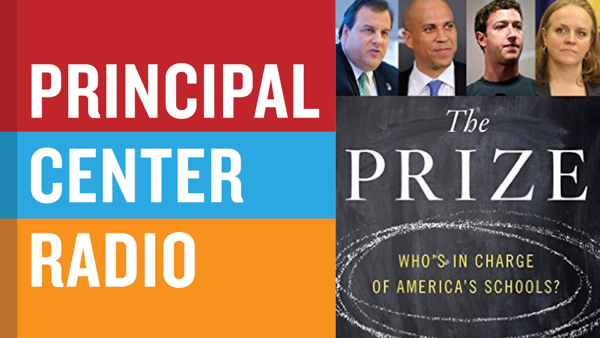
I'm your host, Justin Baeder, and I'm thrilled to be joined today by Dale Russakoff, who spent 28 years as a reporter for The Washington Post covering education, social politics, and more. And we're here today to discuss her new book, The Prize, which is based on her reporting for The New Yorker, covering the Newark, New Jersey city schools.
[00:36] Announcer:
And now, our feature presentation.
[00:39] Dale Rusakoff:
Dale, welcome to Principal Center Radio.
[00:40] Dale Rusakoff:
Great to be here. Thanks for having me.
[00:42] Dale Rusakoff:
I wonder if you could catch us up, for those who haven't been following the Newark story, the Cory Booker, Mark Zuckerberg, Cammie Anderson, all of the players that have been making headlines over the past couple of years in Newark. What's the essence of what's been going on and that prompted you to start this book?
[01:01] Dale Rusakoff:
This all started five years ago, actually a little more than five years ago, when Mark Zuckerberg agreed to pledge $100 million to the Newark schools, basically to be used by Cory Booker, then the mayor of Newark, and Chris Christie, the governor of New Jersey, to completely, in their words, transform education in Newark. The state of New Jersey had controlled the Newark district schools at that time for 15 years, and it's now been 20 years, but they had taken them over in the nineties because of just rampant corruption in the management and finances of the school district and just total neglect of children and education uh... and so for those all of that time the state had been in control and it had cleaned up some of the corruption but really had done
[01:54]
nothing to improve well I would say nothing really measurable to improve education in the city and so Booker and Christie as great advocates of the education reform movement and charter schools decided that they would take this opportunity of Christie being governor and sharing the same ideas that Booker had to just impose a solution on the school district, which they saw as dramatically expanding charter schools and bringing very strict accountability to everyone who worked in the school district. Booker said that they were going to, quote, flip a city. And Mark Zuckerberg, when this was announced actually on the Oprah show, He said that he was making this money available so that Booker and Christie could create a model of educational excellence for the nation.
[02:46]
And it was his hope that in five years they would emerge with a model for how to transform a failing urban district into a successful school environment for all kids. And then he would take that model to city after city using his philanthropy to basically change the nature of education in urban America. It was an incredibly, you know, almost dream world version of a vision of how to change education. Slightly ambitious, slightly unrealistic, and very naive, I guess.
[03:18] Dale Rusakoff:
And I think very well intentioned at the same time. And that ambiguity or that kind of mixed bag of both intentions and ability to actually pull things off is what makes the story so interesting, as well as the number of different players from different perspectives. As you mentioned, Chris Christie and Cory Booker are not exactly on the same side of the aisle politically. Am I correct about that?
[03:42] Dale Rusakoff:
That's right. Booker's a Democrat. Christie's a Republican. Booker's from urban America, Christie's from suburban America. But it's not uncommon to find people from different sides of the aisle who share the same views of education now.
[03:56] Dale Rusakoff:
Absolutely. And that commitment to kids, I think, is something, you know, that we all share. But exactly what we do about it, you know, what we do to fix systems that have been less than fully functional for a very long time, certainly is a complex challenge and not a Not a simple question to answer. What were some of the immediate actions that were taken with the Zuckerberg's money when it was given to the New York City schools? And I should say, this is a heavily charter school district already. Is that correct?
[04:28] Dale Rusakoff:
It was about 20% charter. And as a result of the expansion that they used the philanthropy for, Within a couple of years, it's going to be about 40% charter. But when you were saying that this was an ambitious plan given how broken the systems were. You said in an effort to improve systems that had not been operating effectively. I mean, I think that that was part of the misconception here was that it was about fixing systems, you know, systems change as if something needed to be done at the management level, at the incentive level, when really, you know, the biggest part of the challenge was how to educate children who are living in extreme poverty, who witness violence regularly, who suffer trauma, who have family instability, all the issues that extreme poverty caused for kids.
[05:22]
You know, certainly having a well-managed system is important, but, you know, not concentrating a lot of the money and time and energy on understanding what the needs were at the classroom and school level seemed like a big mistake from the beginning. When you ask like where did they first start spending the money, the first couple of million dollars went on a PR campaign. It was called a community engagement effort as if it were about engaging people in Newark in in coming to the table and helping to think through what the needs were. But in fact, they already knew what they were going to do. And this was a series of 10 forums in which they were just going to basically allow people to come in thinking that they were contributing to this thought process.
[06:13]
But in fact, there was already a plan and this was almost like window dressing and they hired a consultant from New York City who had been an advisor to the charter school movement. and to Mayor Michael Bloomberg in his reelection campaign, who knew nothing about Newark and nothing about the schools or the children of Newark. He just knew about how do you advocate for charter schools, and that was what his whole mission was.
[06:41] Dale Rusakoff:
So it sounds like there was already a view toward the national stage with these early moves, but the local community, how did the local community react to these pretty sudden and dramatic changes within Newark?
[06:55] Dale Rusakoff:
I guess I forgot to mention that nobody in Newark knew about this until it was announced on the Oprah show September 24th, 2010. Oh, wow. Yeah. So the parents of the school children whose schools were going to be supposedly revolutionized and saved learned about this at the same time that Oprah's national television audience learned about it. And while I think that people who heard this announcement on Oprah...
[07:20]
across the country thought, gee, the people of Newark are so lucky to get this $100 million. And the reaction in Newark was somewhat, gee, this is a windfall. But also, what is really going on here? How come we had to turn on Oprah at 4 o'clock to find out about this? And there was immediately a suspicion that this was something that Cory Booker and Chris Christie were trying to do for their national reputations, but that it wasn't really about the children of Newark. And the fact that it was being called, you know, that we're going to create in Newark a national model to solve the problems of education in urban America.
[07:58]
You know, made people wonder, aren't we a specific city? Aren't we an ecosystem with our own issues that need to be studied and understood? Are we just a laboratory for the rest of the country? So, you know, from the beginning, it wasn't universally welcome.
[08:14] Dale Rusakoff:
And once the changes started to roll out, did you see kind of a spike in opposition or did people kind of get on board once they saw good things happening or how did that play out over time?
[08:25] Dale Rusakoff:
Well, I think in general, the opposition grew as the ideas came out because, again, these were ideas that were being brought in by politicians. people who said, you know, as Christy put it, we know what's right and let's do the right thing. And Booker said, we know what works. And there was this assumption that if you expand charter schools and bring in, you know, accountability and incentive systems at the top of the public, the traditional public schools, that that will solve things and that we know how to fix this. And there wasn't a focus on the needs that the kids had in the schools and in the classrooms and how much more resources the schools needed to address those issues. I mean, interestingly, I followed one particular charter school very closely, and that school
[09:19]
got more money to hire and pay teachers and social workers and tutors and even a dean, an additional dean that you would have never seen in the district schools, all to be part of a system of supporting students who were behind, students who had emotional trauma that prevented them from learning. And those resources made it possible for that school to support kids and teachers in a way that district schools simply can't. even though district schools start out with more money, less money reaches the school in the classroom. And so the principal doesn't have the resources to kind of build the school around the needs of the children, which is what this particular charter school was able to do with the money that got to the building.
[10:02] Dale Rusakoff:
Yeah, I was astounded to read that in many of these schools, there are two teachers in the early grades classrooms.
[10:10] Dale Rusakoff:
Yes, the KIPP schools and the uncommon schools. have two certified teachers in grades kindergarten through third. And so they can teach the children in smaller groups.
[10:23]
If part of the class is on grade level and part of the class is not, they can break them down and give them the attention they need to keep moving ahead. And they had in the KIPP school that I spent my time in, they had a tutor or an interventionist, but in effect a tutor for every grade who could push in and work with the kids who were having too much trouble to keep up even with the two teachers in the room. And in the district school, the several district schools that I followed, there was maybe one tutor for grades one through five, but certainly not one for each grade. And in this KIPP charter school that I followed, they had three social workers for 520 kids, whereas the district schools had one for an entire school of 650 kids.
[11:17]
So these three social workers in this particular school were doing therapy with 70 children a week, children who had emotional problems that would have otherwise kept them from learning. And as I said, the district school social worker didn't have time to do therapy at all because she was so busy just juggling the needs of 650 kids and the teachers who were trying to reach them.
[11:37] Dale Rusakoff:
We hear that phrase, doing whatever it takes for kids, but I think that phrase is often used at the personal level. I'm personally going to work longer hours and work harder and care more to do whatever it takes for these kids, but we're really talking about something at the systemic level where we're saying, okay, our kids are coming to us with these severe emotional needs or these major life needs that we can support through additional teachers, through additional social workers, through things that are able to be represented on a spreadsheet in some ways if we look at the systems level. Why do you think that is being done in the charter schools in Newark? but so much less common in the public school district.
[12:22] Dale Rusakoff:
You know, I should say that I witnessed it in this one particular charter school, and I shouldn't generalize to say this is what they're doing in every charter school. But what it illustrated to me is what's possible if you get money to the classroom, if you get money to the school. The school district in Newark just is not doing that. I mean, there was...
[12:43]
I in this the district school that is in the district K to 8 school that is in literally the poorest catchment area in Newark gets under ten thousand dollars per student to the building whereas the charter school that I followed starting with less money got 12 to 13 thousand dollars per student I believe the district school actually got It was under $8,000. So the charter was getting almost half again as much money to the building. And this particular school had a principal who just seemed to be very gifted at thinking about what you said, like think of it as systems. What systems do you need in the building? You know, like this whole, the reformer's idea was management systems, top level systems, accountability, efficiency.
[13:36]
But when you think about what are the supports that you need for the children in your building? And maybe it would have been different in a different building with different children. But this principal thought about having extra teachers in the classroom, extra tutors for each grade level. There was a dean whose title was Dean of Student and Family Engagement. And her job was to develop literally systems of support for kids whose needs couldn't be met just in the classroom. So one thing she did was she would look for an adult in the life of this child who would be responsible for kind of making education something important in this child's daily life, even outside of school.
[14:18]
And sometimes it was a parent or a grandparent, but if not, it was a neighbor or a family friend. In one case, it was the stepfather of a boy. This man had just come back from prison and desperately wanted to play a role in his stepson's life. And he was like made the person who was going to be responsible for this kid. You know, almost like kids have a godfather or godmother to be responsible for their religious education. Well, they made sure these kids had, you know, a person who had that role in their secular education.
[14:49]
And, you know, it was just, it just seemed like, you know, like you said, It's not about saying to the teacher, just give this your all and work day and night and come in early and stay late and give the parents your cell phone numbers. It was building a whole system. supports within this school so that teachers had the support they needed to bring the best that they had to the kids.
[15:12] Dale Rusakoff:
I think that's a very compelling lesson for us on the front lines of education that, you know, we absolutely have to look at what our students need and see if we're providing the level of resources, you know, just in terms of staffing, in terms of realistic caseloads for people like social workers and counselors who are supporting our kids and making sure that they're able to be present and to be you know, ready to learn on a daily basis. As I look through the appendix of your book, where you have an appendix titled Where the $200 Million Went, and I guess it ended up being $200 million that was ultimately put into these reform efforts, I noticed that, first of all, almost none of it went to professional development or what you'd consider in the instructional category.
[15:57] Dale Rusakoff:
Right. The main characteristic of it was that it had like a five-point rubric and each part of what the teachers were expected to do was defined in a very granular way, like what creating a culture of excellence in the class, I mean a culture of achievement in the classroom so that, you know, what was the teacher, you know, the teacher had to do, you know, certain things to communicate to the kids that they should always be trying to get, you know, more and more proficient and not just be satisfied with where they were. And they wanted the, this was also as kind of taken from the Common Core. You know, the Common Core has a whole format that is meant to, that each lesson is meant to build on the lessons that came before it and each grade is meant to build you know, on the grades that came before it.
[16:49]
And so, you know, they wanted, one of the things the teachers were supposed to do in thinking through their week and their month and, you know, all of their lesson plans was to be drawing on what the children had already learned and bringing that to bear in what they were teaching the next day and the day after that. So those were, you know, those kinds of kind of granular level things. And they did, you know, use some, but just a very small amount of the money to train the principals in, you know, how to guide teachers to teach this way. But in terms of just, you know, a dramatic amount of money on professional development, no, it wasn't.
[17:27] Dale Rusakoff:
Yeah, I'm noticing a lot of money spent on data systems and kind of HR overhauls and contract buyouts and lots of things that perhaps were overdue or were helpful in some way. But I think, as I said, some of the most compelling takeaways were at the front lines. We hired additional staff to work with our neediest students, and we figured out what it takes at the school level to meet their needs. And I think that's very important. a very powerful lesson for us.
[17:58] Dale Rusakoff:
Yes, and I think, you know, I mean, I think that the reasoning was that, you know, if we just add money to the classroom, even if we add it in a, you know, smart, strategic way, when the money runs out, what is the district going to do about that if they can't afford it? You know, so that was kind of their reasoning for let's fix the systems, and those will be permanent changes. But I think that... you know, that since you could see from this one charter what all this money could be doing for kids in classrooms, it would have been really valuable to figure out how to restructure the central office, you know, even if that involved, you know, changing union contracts and changing civil service jobs, which is, you know, is an incredibly challenging political thing to do.
[18:45]
But even, you know, even figuring out the roadmap for how to get there, you know, would have been so powerful because you can see that there are resources that can help schools and teachers and kids make education better. And, you know, it just seems like that would have been a very valuable thing to do with this money for the long term. Right.
[19:09] Dale Rusakoff:
Yeah, when I think about other districts that have been through pretty dramatic, you know, reforms or breakages and reformations. And to start with a more moderate example, in Seattle Public Schools, our district did a lot with Meredith Honig's research on central office transformation and kind of recasting the role of the central office. as being in support of schools and being in support of principals, in support of instruction, rather than being a hierarchy where the schools work for the district and work for the superintendent, recasting that as a support role. But then we see also this kind of cynicism and frustration toward the central office, which we didn't have nearly as much of in Seattle. We had a few kind of financial issues and scandals and things like that. But I think about the Memphis City Schools that essentially gave up and they said, we're broke and we're broken.
[20:06]
So we're going to give up our charter as a major urban district and just be absorbed into the county. And I think about New Orleans, which was kind of wiped out by Hurricane Katrina and came back as a as a charter district and think about just what happened in Newark and think about the frustration that people feel thinking, okay, we've got this huge bureaucracy, this huge machine that ostensibly is to serve students' needs, but you have a phrase that basically Newark was serving in some ways as having to deal with the legacy costs from having served as an employer of last resorts for decades, is one of the phrases you use in the book. What do you think that means as far as an employer of Last Resort?
[20:53]
And did you see any paths out of that?
[20:57] Dale Rusakoff:
The meaning is that, you know, this was a city and still is a city that just suffers from grinding poverty and extremely high unemployment. And in past years, just, you know, political bosses controlled the jobs in the district. So if, you know, if somebody came to them and was, you know, really struggling, they could get them a job in the district. And one of the, I mean, the interesting thing is these aren't necessarily high-paying jobs. In fact, they're concentrated at the lower level. So one of the things that one analyst came up with was that Newark has, for its size, three times the number of clerks that the average school district in America has.
[21:36]
And even in some cases, clerks themselves had clerks. And so if you look in the private sector, one clerical person will work for multiple professionals. But in Newark, individual professionals had multiple clerks. And this was a legacy of the sort of old way of doing business in Newark. And there have been a lot of layoffs of the lower skilled workers over the years because the reform effort resulted in a big, big deficit or budget gap because with such an increase in the charter schools and kids leaving the district for charters, the money was leaving with them and the district couldn't downsize easily. And so they just, they laid off security guards, custodial workers, clerks, you know, a lot of the people at the lower end of the pay scale.
[22:32]
And interestingly, the superintendent, Cammie Anderson, you know, lamented this and said, you know, we're increasing poverty in the name of school reform.
[22:41] Dale Rusakoff:
Wow. Quite an irony there, huh?
[22:42] Dale Rusakoff:
Yeah. I mean, it's just like you're always at a tipping point in a city like Newark. You want to downsize and kind of make the district on a solid financial footing as it loses students. And at the same time, the people you're laying off may be the breadwinner for a family that has children in the public schools. So you're improving the schools perhaps, but...
[23:10]
the children's lives are not necessarily in good shape at all.
[23:14] Dale Rusakoff:
Right, because as in many communities, the school district itself is the largest employer.
[23:20] Dale Rusakoff:
Yes, it is. It's the biggest public employer in Newark. And in fact, it's the biggest employer of any kind in Newark except for United Airlines.
[23:27] Dale Rusakoff:
Well, Dale, in putting together the prize, you got to speak with Mark and Priscilla Zuckerberg. You attended a lot of meetings with Superintendent Cammie Anderson as well as public meetings in the community. I rode around with Cory Booker and Chris Christie in their meetings. SUVs to see what was going on. But what happened in the principal's office? What did you see at the level of school leadership that has stuck with you?
[23:54] Dale Rusakoff:
I think the most memorable thing for me was getting to watch the work of one principal in a school called Peshine Avenue School. This was a school that had been, that it was located in one of the poorest sections of Newark, the South Ward. And it was a very low performing school. And it was combined with another school called Dayton Street School that was, I think it might have been at the time, the poorest catchment area in Newark. And they closed the Dayton Avenue School and merged it into Peshine. And the children from Dayton were bused to Peshine.
[24:29]
And it was an extremely tumultuous thing for the kids and the teachers in the school to go through. But what was really striking to me was the role of the principal. She was quite young. She was only 32 years old. But she had been the principal at Dayton Street School. And she had taught...
[24:47]
She had taught for five years at Peshine Avenue, five years at Dayton. Her mother had been a teacher for 37 years at Dayton. So like some of the Dayton teachers knew her mother as well as her. And the principal, Shalita Barnes, had such credibility in the community and a relationship with everyone. But she also had this real commitment to being an instructional leader and to helping the teachers who worked for her get better. and to do observations and feedback that were really constructive and supportive.
[25:25]
The previous principal was known for just doing, I mean, every time she came in to do an evaluation, it turned out to be harsh and kind of arbitrary, and there was never anything from it that was, you know, that was used to help teachers improve. It was just kind of a punishment. And Shalita Barnes started with, and with her whole team, she had two assistant principals and they all had this philosophy of, that we're here to help our teachers get better and stronger. And the teachers in that school said they became, like for the first time they collaborated with each other and they felt that when the principal or the assistant principal came into the room that they were going to get better, not that they were going to get punished. And they welcomed the observations. It was a complete cultural change that this principal was able to bring throughout the building just by the force of her personality and her authenticity.
[26:23]
as a member of the community. And, you know, at the end, this school went through a lot. They were designated as a renew school, which meant that the teachers had to work longer hours, and they had to work two, I think it was actually three weekends a year and two extra weeks in the summer. And the new contract required them to do all this for a stipend of $3,000, which came down to about $10 an hour. And there was such a revolt in the school and the teachers were all going to leave the school to try to, you know, in protest and go to a different school that wasn't, that didn't require all these extra hours. And in the end, nobody left because one by one, they all felt that it had been such a positive experience to work in a school with a principal like this, that they would rather do that.
[27:13]
than have shorter hours and the chance to have a part-time job and make more money. They all said that this had been their best year, some of them 30 years in the district, their best year working for a principal who was really committed to supporting them. And now I have to say that the school did not have a dramatic academic turnaround, but that was partly because the resources just weren't there As we were talking earlier about what this charter school was able to get to the building, they didn't have the money to have extra social workers or extra tutors. And the children, because they were from such poor areas and combined into one school, there was a lot of concentration of the problems of poverty. But what you saw happening at that school was just a tremendous...
[28:05]
uplift of the staff and a sense of possibility that they'd never had. And I really think if they had had just a little bit more support, that could have been quite an amazing story about what the role of a principal can be in changing a school.
[28:21] Dale Rusakoff:
Absolutely. And just to have no one leave when something that dramatic happens or even to have no one leave in any given year, I think really is a testament to how much those relationships matter and how much it matters to teachers to be noticed and to be heard and not just evaluated, but to be supported, to be involved, to be consulted as participants in instructional leadership. I think there are so many powerful things we can take away from that.
[28:48] Dale Rusakoff:
Yeah, and you know, it's so true when you see that the research on merit pay is that merit pay doesn't really have an effect on teachers. It certainly doesn't have an effect on their practice. And so many teachers say that given a choice, If they had to say, what would you really like to make your job better? They would say a great principal before they would say merit pay. And watching this school, Peshine Avenue School, was really a chance to see that in practice.
[29:17] Dale Rusakoff:
So the book is The Prize, Who's in Charge of America's Schools? A great read and a very compelling story about a particularly compelling case in American public education. Dale, thank you so much for joining us on Principal Center Radio.
[29:32] Dale Rusakoff:
Thank you, Justin. It's great to talk to you.
[29:35] Justin Baeder:
And now, Justin Baeder on high-performance instructional leadership.
[29:39] Dale Rusakoff:
So high-performance instructional leaders, what did you take away from my conversation with Dale Russikoff? It reminded me of an earlier conversation I had on Principal Center Radio when I interviewed David Kirp of Berkeley about his book Improbable Scholars, The Rebirth of a Great American School System and a Strategy for America's Schools, which is also about a New Jersey school district that is viewed as, in some ways, a national experiment and a national model. for urban schools. But in Union City, which is the focus of David's book, there have not been dramatic changes. There have been gradual changes to take a very high poverty community and have a very high quality school district and excellent results for students. So it's very interesting to compare that case to the case of the Newark City schools, where there has been a lot of money and a lot of dramatic change and a very different set of results to show from it.
[30:32]
But one thing that I took away from my conversation with Dale today was this idea of commitment, that we have to be committed at multiple levels, both at the systemic level and at the personal level. And we've seen a lot of money committed. We've seen a lot of political will committed by various parties to the Newark City Schools. But what makes the most difference for students is what our commitment at the front lines is. And we have this idea, this phrase, whatever it takes, that we'll do whatever it takes for students, even if that means working long hours, even if that means staying late, even if that means giving out our cell phone numbers, as Dale mentioned. But I think what really matters is...
[31:12]
systemically is doing whatever it takes as a system. And I was really impressed by the fact that in a lot of these schools there are two kindergarten teachers. There are two first grade teachers for every classroom because that's what students need. So I think we need to take that phrase, whatever it takes, and we need to stop looking at it as just a matter of personal heroism and sacrifice, and we need to look at it as a systemic issue, that our system needs to be designed to give students what they need, even if that means we're pulling resources from somewhere else so that we can provide to teachers in every classroom if that's what our students need. So again, the book is The Prize, Who's in Charge of America's Schools? And I'd highly recommend that you take that with you on your next time away from school when you have some time to do some reading.
[32:02]
A really compelling story by a terrific journalist. And if you're interested in building capacity for instructional leadership in your school, as we talked briefly about toward the end of the interview, I want to invite you to check out our program at the Principal Center. It's called the High Performance Instructional Leadership Network. You can find out more at principalcenter.com slash leadership.
[32:23] Announcer:
Thanks for listening to Principal Center Radio. For more great episodes, subscribe on our website at principalcenter.com slash radio.
Bring This Expertise to Your School
Interested in professional development, keynotes, or workshops? Send us a message below.
Inquire About Professional Development with Dale Rusakoff
We'll be happy to make an introduction.