[00:01] Justin Baeder:
Welcome to Principal Center Radio, bringing you the best in professional practice.
[00:06] Announcer:
Here's your host, Director of the Principal Center and Champion of High Performance Instructional Leadership, Justin Baeder. Welcome everyone to Principal Center Radio.
[00:15] Carla Tantillo Philibert:
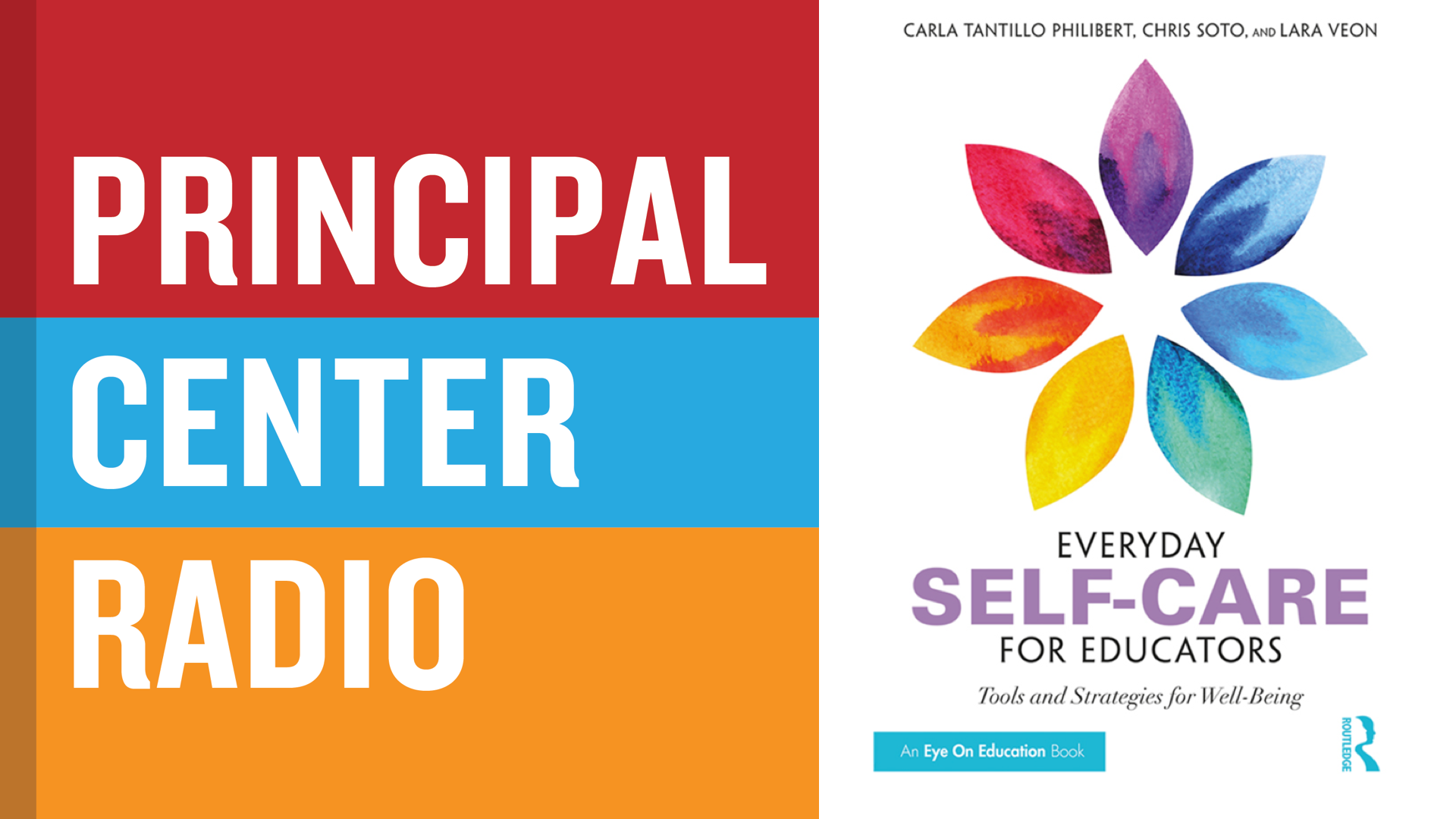
I'm your host, Justin Baeder, and I'm honored to be joined today by Carla Tantillo-Philibert. who is the founder of Mindful Practices. Carla is a sought-after speaker and consultant on social and emotional learning and the author of Cooling Down Your Classroom and the Everyday SEL series for early childhood, elementary, middle, and high school teachers, as well as the founder of the Class Catalyst app and the author of the new book, Everyday Self-Care for Educators, Tools and Strategies for Well-Being, which we're here to talk about today.
[00:47] Announcer:
And now, our feature presentation.
[00:50] Carla Tantillo Philibert:
So, Carla, welcome to Principal Center Radio.
[00:52] Carla Tantillo Philibert:
Thank you for having me, Justin. I am really honored to be here.
[00:55] Carla Tantillo Philibert:
Well, I'm excited to speak with you because you've been an expert and sought after leader in this field of social and emotional learning for a long time. But with this new book, Everyday Self-Care for Educators, you're turning your focus not to students, but to educators who are doing this work of engaging students' social and emotional needs. What did you see happening in the profession that prompted you to start to focus on educators?
[01:21] Carla Tantillo Philibert:
Oh gosh, thank you, Justin. That's such a great question. I think so timely. We're living in a country that values education for sure, but we're also living in a country that doesn't always value its educators. And I was guilty of this myself, both as a teacher who spread myself too thin and volunteered for every committee and every task force, and then as an administrator that saw those go-getter teachers and voluntold them, if you will, be on this one more committee or, you know, organize this one more thing. And I think I saw teachers burning their candle at both ends, as my mom would say.
[01:58]
I saw administrators doing the same. I saw, you know, especially as the opioid epidemic increases in our country, I saw secondary trauma in both, you know, educators, administrators, school stakeholders generally. And And when I would bring this up or when this would be brought up to me, it was part of discussions in the work that I do across the country. The number one obstacle to this was time. We don't have time to take care of our teachers. We don't have time to take care of ourselves.
[02:31]
And while that is a real obstacle and one that I address and that we address in the book, it is something, it's not a good enough excuse. We have to take care of the people that are taking care of our kids.
[02:42] Carla Tantillo Philibert:
Well, and I think the flip side of that argument is one that we too readily accept, this idea that as educators, we need to be willing to do whatever it takes for our students. But sometimes whatever it takes is not actually a sacrifice that we can make on behalf of other people or should be making because it's not sustainable. So what did you see happening in educators who had that really high level of commitment? What toll was that taking on on their own wellbeing, their own health and so forth.
[03:15] Carla Tantillo Philibert:
Gosh, and thank you for saying that out loud, Justin, because I think there is a climate and culture to education as a field where self-sacrifice is something we reward with merit. Oh, look at how committed Justin is. Look at how committed Carla is. They're burning it at both ends. Wow, they really care, right? They get a star.
[03:36]
And I think that that's toxic, and it's something we need to move away from. And that was what I saw. I saw this over-reliance upon a couple go-getters in school buildings. I saw a culture that gave permission to burning it at both ends, permission and almost rewards and accolades for those people that were doing so. And then also an additional layer was that as teachers are burning out and as we're seeing our attrition rates rise, then we also, there's this necessary acceptance of teachers that aren't trying that hard, that teachers that don't really like kids and need to go, but because our attrition rates are rising because we're burning out our good teachers, our committed teachers, then we're keeping our teachers that are kind of meh, out of necessity, right?
[04:26]
And we need to instead have a culture that we take care of our teachers, we value them as people, we value them as folks that can model self-care and well-being for students, right? Because that's what we want. We want those practices modeled for students. And a lot of times, instead, it's like, burn it at both ends, show us that you care about kids. That's not helping anybody.
[04:47] Carla Tantillo Philibert:
Well, and then we wonder why we're getting burned out people when we've asked them to burn the candle above us for so long. Absolutely. Exactly. And that is such a contrast to me to just the professionalism that people bring to their work and the professional way that people are treated in other professions. I feel like there's a mismatch between the way that we ask people teachers to be professionals but then have these kind of unsustainable and not really very professional expectations, you know, of do 10 hours of work after school, you know, to get ready for tomorrow and make sure that everything is aligned with everything and everything is perfect. And I appreciate your point that often we know we can't replace those people when they burn out, so we have to tolerate things that are also not where we want them to be.
[05:38]
So what are some of your recommendations? So take us into a little bit of what you see as the solution to this. For educators who do care, they don't want to phone it in, they don't want to cut their effort in half, but they know they need to do something that's sustainable.
[05:54] Carla Tantillo Philibert:
What a great question, Justin. Thank you so much. So I gave a presentation last weekend at a principal and a leadership conference in Boston. And when you think about the recommendations, it all starts with leadership. And I shared some things. And what I shared with the administrators and the leaders in the room was, instead of giving you, here's five magic things to start doing, 10 more things to start doing, You know, I said, well, often what happens is leaders or teachers, we go to these educational conferences and we collect and collect and collect more ideas and more initiatives.
[06:28]
And then we go back to our school. We almost have like a junk drawer of all of these ideas that we collect at conferences. And instead of giving you five more things to have your teachers do or three more things to do, I said, I'm going to give you three things to stop doing. One of those things to stop doing is stop having your teachers, asking your teachers to be in committees constantly to create Google Docs that they never use. We really need to think about when we ask our teachers to do something, we need to think about the time commitment first and the outcome first. Does that time commitment, if it's 10 hours a year, what do teachers have as a final product at the end and how does it serve them and how does it serve kids?
[07:09]
And if we can't answer those questions, then stop asking your teachers to be in committees, right? And, you know, in the faces of the administrators in the room, you know, where you think they would, you know, boo and hiss and, you know, throw me off stage, they were nodding because we get that, like, we're all well-intentioned in schools and we all see numbers that cause alarm, whether there are teacher attrition rates, whether there are student attendance rates, And then we say to ourselves, oh, shoot, we can do this better. Let's form this committee. And we're committing our teachers to the point of exhaustion. And so instead, let's really say, let's honor time. Time should be the number one question.
[07:49]
And when we're asking our teachers to spend their time, how are they spending it? And does the way that they're spending their time connect them back to the reason they wanted to teach in the first place? And so, for instance, you know, if we look at John Hattie's work, John Hattie has told us, everyone stop spending billions of dollars on who's in the what's-its and all these fancy-dancy programs. John Hattie tells us the number one thing, folks, are relationships between students and teachers. That's the number one thing that has impact for students. Awesome.
[08:21]
We talked to our teachers, right? I did some work. with the University of Chicago Chapin Hall, my research partner there, Dr. Kim. We've been studying teacher social emotional learning competence. We've included wellbeing questions in our surveys to the teachers.
[08:35]
The number one thing, the reason teachers are there, the reason they got into teaching in the first place is because they were impacted by a positive relationship with the teacher themselves. They want to have that impact via a positive relationship with a student. The problem is they don't have time. So again, when we get back to what can we do differently in schools, we can honor our teachers' time better. And we can stop saying, Pants are on fire, more committees, more task force, and instead say, let's look at our minutes every day. And instead of adding more things to teachers' plates, well-intentioned or not, let's take things off their plates so they can do the thing that's going to feed them the most and going to feed our students the most, which is building relationships.
[09:23] Carla Tantillo Philibert:
I think it's so easy for us as leaders to identify a new best practice or identify a new improvement priority and look at the time available each week that teachers are not in class, actually teaching students. Or if we're talking about something instructional, to look at their instructional minutes and say, well, yeah, we can fit that in. And forget that we already said that last year about something else. And we already said that three months ago about something else. So we're double and triple and quadruple booking our teachers for their instructional time, for their prep time before and after school. And the reality is that a lot of people are getting all of whatever we've asked them to do done by putting in an incredible amount of basically unpaid overtime.
[10:05]
And, you know, we don't even think of it that way because there's no overtime for teachers, right? Like it's just, you know, you do what you need to do, whatever it takes. And this idea of a boundary around how long a teacher's workday should be, if their prep time is really their prep time, or if we can kind of claim it for other priorities. Those are just not conversations that we're having often enough in our profession. So I definitely appreciate the importance of starting with leadership and recognizing this as a problem that we have created in our drive to get better results and in our drive to improve. We've got to recognize that teachers are personally paying the price for that in too many situations and we're not taking responsibility for that as an organizational level decision and resource that we have to budget because you know in many cases we've already spent all of teachers prep time before the new priority comes along.
[10:58]
So if a teacher is in that situation where they feel like their school, their district is always giving them more and more to do, and they feel like they, you know, I need a boundary. I need a way to carve out some protection for myself so that I can build relationships with my students. I can prioritize that, relationships with families. I can plan my lessons. I can assess student work and do what I need to get done and still not be working 80 hours a week. What are some strategies that you have in the book for that self-care angle and for that element of creating boundaries?
[11:28] Carla Tantillo Philibert:
Right. And that's been really tricky. And truthfully, it's interesting because when we look at the book, you know, the book is short and the book is short intentionally, right? Because you look at these self-care books, they can be like tombs of requests, right? 17 journals a day and, you know, go for a three-hour walk and look at butterflies. And that's awesome, but no one's got the time for it, right?
[11:49]
And so we were thinking about how can we create quick and intentional strategies for teachers to use, so most of them around breathwork. We do talk a little bit about boundaries in the book and talk about how we really encourage administrators to create a culture where boundaries are expected and accepted. And with the professional development that we do around this topic, we do a lot of role playing around boundaries and around teachers requesting and stating boundaries. What is hard is that, and this has to be said, that unless the administrator is aware of the need for this, unless the administrator creates a climate and culture that accepts that request, then
[12:41]
it can be detrimental for that teacher to speak the need for a boundary. Like, that's the reality. And that's what's really hard, right? And that's what we wrestled with with the book is, you know, we want to encourage our teachers to find their voice, to find their words, to advocate for their needs. But again, as you said, the climate and culture of teaching is one where if a teacher says, I can't be on that committee, right, for whatever reason, because they want to advocate for their own self-care, because they want to advocate for more family time, et cetera, is that going to hurt their career? And right now, that answer is probably yes.
[13:21]
And so when writing the book, we wrestled with this. We want to empower teachers to advocate for boundaries. But more so, it has to start that the administrator can say out loud to their team, listen. This is something we need to do better as a district. This is something I need to do better as a superintendent or a principal. Engage in this conversation with me.
[13:42]
Let's co-create this together. And until that happens, then I fear that we might be setting our teachers up for something that's less than positive if we say, go advocate for yourself, advocate for boundaries, and then in a culture that doesn't receive that well just yet.
[13:58] Carla Tantillo Philibert:
Well, let's talk about this idea of breath work a little bit, because I think for most of us, we're familiar with the fact that yoga exists. We're familiar with the idea of taking a deep breath. But beyond that, as a strategy for self-care, I don't know. So help me understand that one.
[14:15] Carla Tantillo Philibert:
Absolutely. So Viktor Frankl said, to paraphrase badly, that what we need is to create space between stimulus and response. And so, so often when we see people in general being triggered, whether it's students, whether it's teachers, whether they're school stakeholders or administrators, myself as a parent, I'm unable to find that space between stimulus, what my trigger is, and my response of losing my cool, rolling my eyes, impulsivity, et cetera. And so what we shoot for with breath work, what we shoot for with mindful practices in the classroom or yoga in the classroom is the practice of finding that space between stimulus and response. And so to practice that effectively, we need to be plugged in to our bodies.
[15:12]
We need to be plugged in to our bodies. And to do that, the route, the entry point is the breath. The breath is something that no matter what is happening in our lives, chaotic or not, we can control our breath. and we can regulate our breathing. And by regulating our breathing, right, we're able to regulate our responses. And so, so often I think what happens when we talk about social emotional learning, for instance, we talk about that as something that teachers do in classrooms to get students to behave a certain way.
[15:49]
If we only do more of this, if we only, the teachers only teach more lessons about this, right? then students will do X. That's not the end game. The end game is for the students to cultivate the self-awareness where they can be their best selves in the world. And so often that's by them, again, back to our friend, Viktor Frankl, being able to find that space between stimulus and response, be able to pause, own what's going on with them, find a breath. And in that three seconds, in that three seconds, be aware of what their needs are Be aware of how they're responding in the moment.
[16:28]
To me, that is that intersection of mindfulness, breath work, social emotional learning, that critical piece. That is like the bedrock. When we talk about social emotional learning, when we talk about mindfulness and yoga, that to me, that's why this work belongs in schools. Because we so often, we talk about behavioral expectations, but it's all through the lens of the teacher either observing what's happening with the students, requesting something of the students. What we want is to think of our students as lifelong learners, to think of our students when they exit our schoolhouse doors. And what we want is for them to be happy, contributing citizens of the world, citizens of the world who can engage in conversation, right?
[17:10]
who can be positive, who can be proactive. And to do that, move away from reactivity and move into being present and focused and intentional.
[17:20] Carla Tantillo Philibert:
And as you said, modeling that for students, if we want them to exercise those same habits of self-awareness and self-regulation, we've got to do that as educators. We've got to lead the way.
[17:33] Carla Tantillo Philibert:
100%. And we have to make time For those practices. And so my work and the work of my team, my mindful practices team is again like providing job embedded professional coaching to teachers and educators and school stakeholders so we can model those practices for them in real time. Supporting teacher skill sets, not assuming that every teacher comes to the mat with the same competency around this. Everyone has different triggers. Everyone has different layers of self-awareness and self-regulation.
[18:06]
I'm on the chat with you, I'm regulated. I'm on a chat with my mother-in-law, maybe not so much. You know what that is? You know, these things are contextual, they are fluid. And so at the end of the day, where's the importance lie? That the students get their 15 minutes of social emotional learning a week, check.
[18:24]
You know, that we taught them the bullying lesson. Hopefully when it, you know, all goes down on the playground, that kid will be, no, no, what do we want? We want our students to be able to practice strategies. And if it's not breath work, It could be movement. It could be jumping jacks. To me, it's not the practice that matters.
[18:42]
It's the students realizing, having that awareness that this practice, whatever it is, helps them be more present and therefore more regulated. But our teachers have to have the time to do that. And our teachers have to have the time, as you mentioned, to model that as well, practice that as well for themselves and show their students that piece because that's critical, that's vital. Because then students are learning positive ways to regulate. you know, I say it's awesome when teachers walk into a classroom and say, Hey, it was stuck in traffic for 30 minutes. I'm really dysregulated.
[19:13]
Can we practice some jumping jacks, some breath work, some yoga, whatever it is together. Then students say, Hey, Ms. Thompson was dysregulated. She was agitated. She was triggered. And she used this to help because our students most likely, or maybe aren't seeing positive practices at home or outside of the schoolhouse doors.
[19:32]
You know, I say that with my work with the communities, especially in, um, on the East Coast or in New Hampshire that are being impacted by the opioid epidemic. Students aren't seeing positive practices when adults are dysregulated. So let's model those positive practices in the school during the school day and especially helps the teachers, it helps the students, it helps the school community.
[19:52] Carla Tantillo Philibert:
Absolutely. I feel like this might be a good segue into talking about Class Catalyst because you've been working to not only train people on these strategies, but also to provide support in the form of an app. So take us into that a little bit. What is Class Catalyst and what does that allow people to do?
[20:11] Carla Tantillo Philibert:
Oh, thank you so much. And so Class Client List is a platform that I co-created with my research partner, Dr. Kiljean Kim at the University of Chicago Chapin Hall, and my husband, Rob Filiber, who's a senior creative director and a whiz in the tech space. And one of the reasons is, you know, we, again, we're working with communities, high poverty communities across the country. So on average, my organization, Mindful Practices, works with about 75 school districts a year, providing coaching, support, et cetera. And one of the things that we saw, again, with our research, looking at the teacher self-care side and teacher social emotional learning competency side, is this question of time kept coming up.
[20:55]
Time, time, time. And we saw John Hattie's first book come out. We saw John Hattie's second book come out. Thank you, John Hattie. And people saying, I get it. I want to cultivate meaningful relationships with my students.
[21:09]
But again, as you said so eloquently, Justin, here's another initiative. Remember, don't forget the initiative from 2001. And so people are initiatived out. And we're saying to them, build relationships. And so we really took stock in what we were seeing and stood back as an organization and said, we have to address some elephants in the room here if we're going to do this work well. Because what we don't want is we don't want our mindful practices work to feel like, quote unquote, one more thing on a teacher's plate, right?
[21:42]
Right. I've already got to do this and this and there's new literacy. And now you're asking me to breathe on top of it. And so, you know, it feels daunting. And so, you know, we started to really ask teachers questions. You want to connect with your students.
[21:57]
When would you do that the best? And they're like, well, right now, when my students are walking in the door, I'm just looking at their faces and trying to figure out what's going on with them. And then those, those quote unquote high flyers, like those four or five kids that are really struggling that day, or I know their home situation, I'm going to reach out to them. But then I'm missing, you know, what one of my principals called, I'm missing the silent sufferers. You know, one of our teachers missed a girl who was cutting for multiple months because that, that girl was quiet. She wasn't quote unquote a disruption in class.
[22:26]
And so she wasn't the student with an exploded behavior that was going to get noticed. Yeah. And so you see teachers feeling this sense of powerlessness because they don't know what's going on with their students, sense of powerlessness because they don't have the time to connect with every kid. That's the reason they got into teaching. They know what makes the greatest impact. They've read Hattie, but they're like, I feel out of control in my teaching situation.
[22:50]
And so what we did is we said, what if we create a platform that connects every student with a teacher, with a caring adult every day? And so we had this idea, and of course, again, the thing that was in our mind was time. If we were gonna create this platform, this platform would have to be easy to use and would have to be something that served the teacher versus something that took more time off a teacher's already overcrowded plate or felt like one more thing. And so in the beta, we created a very simple communication tool, if you will. Students check in, teachers see it. and we included a couple activities because we knew that if your students are all coming in with a different mood and a different energy level then they all need a different strategy or a different practice because just as i was saying to you with the earlier question you know i don't care if it's yoga or jumping jacks or running in place or breath work i care that students have a practice they can identify realize why they need it and when they need it that's my end game
[23:57]
Right? I'm in the self-awareness business, right? I'm not in the yoga business or the breathwork business, right? And so we had to, if that's a truth for us, then we had to create a tool that would be able to personalize in real time for students. And so what we did is we created this algorithm with, again, with Chapin Hall at the University of Chicago. This algorithm looks at student mood and student energy level.
[24:21]
And so when a student walks in the door, they check in with their mood, they check in with their energy level, and then they're pushed in activity. right and we worked with trauma therapists on our team and a trauma therapist at Chapin to look at these activities like what are activities if a student is is super high energy but angry what's an activity that would work to help get them present and focused and ready to learn and if they're low energy and lethargic right and and sad what's an activity or if they're if they're really happy in high energy what's an activity right So looking at what my research partner calls the creation of the optimal environment for learning. And so why that's happening on the student. And let's say the students are walking in at eight o'clock. They check in, they get an activity to practice to be ready to learn. What happens on the teacher end is the teacher's there and the teacher has real time updated information on where the students are.
[25:09]
So instead of looking out at the class and seeing only your high flyers, because that's all you have time for, you get to see 28 students in real time. There's a little pie chart and it updates. It updates quicker than your Facebook updates, right? And so teacher students are coming in eight o'clock. It's updating in real time. And so the students are so it's like, oh, the teacher says five students aren't ready to learn the red.
[25:32]
Right. They're angry. They're agitated. You know, there's eight that are yellow. They're either sad. They're feeling low energy.
[25:39]
And so the teacher sees that and can make real time instructional decisions based upon that information, based upon where their students are. And then the best part about it, and I'm really excited, is because, again, we did a beta, we did a pilot in eight different states, looking at demographics from across the country. So not just our own home base here in Chicago, but looking at rural Iowa, rural New Hampshire, right? What do teachers and students need to really feel like this tool, it's worth, so we brought it to three minutes a day. They're like, this is worth three minutes a day of my time because it connects me with kids. It saves time for me.
[26:15]
And I feel like I'm a better teacher. And one of the strongest pieces is that when the students are checking in, they can write a note to the teacher. So I'm checking into my mood. I'm checking with my energy. And it's like one thing I wish my teacher knew that day. And I can type in, my dad is out on parole, or this is happening, or that is happening.
[26:35]
My parents are splitting up, or I just got a puppy. I'm super jazzed, whatever it is. And those notes shoot to the teacher in real time.
[26:42] Carla Tantillo Philibert:
So if we take this idea of greeting your students at the door or having a handshake for every student, the things that we see on social media and practices that we know in terms of just a personal greeting that do help us connect with students, You're saying because students can, you know, check in very quickly with this app and kind of self-assess and share where they are with the teacher in a way that's not, you know, in the doorway of the classroom in front of everybody, there's an opportunity to communicate different and important information.
[27:14] Carla Tantillo Philibert:
100%. 100%. And I love, and I want to make sure I go on record as saying, because it's something I've advocated for for a long time, I love that teachers check in with students when they enter the room. Mm-hmm. And I love that we're seeing more and more of that. The piece that's missing for me is that we're not taking the necessary next step.
[27:37]
So if I'm a student and I'm entering your room, right, and you're standing at the door and you're doing a thumb check with me or a high five or whatever it might be, it's really through this lens of like, how is this gonna go down with you as a member of this classroom today? And that's really important. But if I report that I'm sad or angry or frustrated, you don't necessarily have time to support me with a solution, to triage a solution for me. And the student knows that. There are 27 other kids coming in the door behind me. And so I feel like there's a difference between saying to a student, I want you to be your best self today and I'm going to check in with you, which is important and part of what the tool does.
[28:20]
And then there's also saying, I want you to be your best self in life. And I realize that I, to do that, I have to help you cultivate a regulation, a self-awareness practice. And you might not have that in your toolbox, even though you're 16 year old and not 16 years old and a high school student, right? So I'm gonna help you with that. And I think that we have to say that, It is part of our job as educators to help our students cultivate a healthy practice for dealing with stress, for dealing with anxiety, because we are seeing an uptick, as you know, in suicide and at-risk behaviors, right, and opioid use. And we have our students in middle school, in high school, in elementary school.
[29:10]
We're saying lifelong learning all over the place. It's in every district's mission or vision, or should be, but then we're not teaching a critical component of that. And so we have to create space for students to say, I'm not okay today, and for a teacher to say, all right, try these three things. And then let's check in on where that is. Did that practice work for you? I don't care.
[29:30]
Again, a lot of our schools use doodling. One of my schools in a rural area uses a student where they don't have a ton of warm water, hot water. Students washing their hands in warm water can be soothing. And so again, we don't care what the practice is. We care that there is a practice and we care that the students have time to put voice to what they're experiencing in their own words. And then they're given time to practice a strategy.
[29:56]
And on the regular, not like, again, like not every Wednesday at 2.15 because it's our social emotional learning time, but when they need it, right? Because that's how life is. Life throws these things at you. We as adults have some skills to navigate that. We need to give our students the time to cultivate those skills and practice them in real time.
[30:14] Carla Tantillo Philibert:
So many educators will say, I want to know if my students are having a hard time, but yeah, I don't know what to do for them. I can't fix whatever's going on at home, but I do want them to be able to communicate. And I just love that option of being able to do something quickly at the start of class that's going to be more valuable as a way of getting them situated for the day than say, you know, copying the objective off of the board into the, you know, into their journal or whatever. So these are, you said kind of about three minute activities and a three minute process to check in.
[30:48] Carla Tantillo Philibert:
Yep, this from start to finish, including the activities, it's three minutes. Teachers can even have the students recheck. Teachers can also do like a group activity, depending on, you know, some teachers love to then have the students do individual checks and then facilitate a group activity. But you're, you know, you're right on the money, Justin. You know, a lot of our teachers initially would say, you know, I'm not a trained social worker. I was like, yeah, I know you're not.
[31:13]
And so it's almost like this ignorance is ignorant, willing suspension of disbelief, more like. Right. Like I'm gonna pretend that every student is ready to learn because I don't feel like I have the chops, the tools in my toolbox to handle it if they're not. And partly again, this is where leadership is so important. We need to say to our teachers, we don't expect you to be trained social workers. Absolutely not, right?
[31:37]
And so administratively, we're saying, here is the process. If one of your students reports that they are suicidal, et cetera, you know, all the mandated reporter stuff that teachers already, you know, we're all, that's top of mind for all of us. we're gonna say, we're gonna hold that same space and we're gonna invite more information in. The rules aren't changing, but we're getting rid of the willing suspension of disbelief and we're inviting more information in. We have to, you know, look at our data across the country around suicide. We have to, we gotta drop the veil and we've gotta say, This is our responsibility as educators and that's okay because we have tools like our amazing social workers, like our amazing teachers, like Class Catalyst that can make this possible.
[32:23]
We all just have to arm in arm, say together, this is our job.
[32:28] Carla Tantillo Philibert:
I guess the other thing I wanted to ask, Carla, was this is vocabulary that is going to resonate with people in certain places. And I wonder for our listeners who may be in regions or in school cultures where that vocabulary is going to seem unfamiliar, where the idea of yoga or the idea of mindfulness or breathing might seem a little bit strange. Can you give us kind of a... you know, a translation there for people who might need to kind of explain themselves in ways that other people around them can understand.
[33:05] Carla Tantillo Philibert:
Oh, absolutely. 100%. 100%. So I was working with a fabulous school district that is outside of Indianapolis. And they had the state winning football team the year prior. So I'm working, you know, I'm in the room of all the administrators, the the the high school football coach is in the room and you know, he's a presence.
[33:28]
And of course, you know, revered because you win a state football championship in any state, you know, you're, Hey, you're up there, man. And so, so I'm sitting there and I walk in and I'm talking my, my talk, Justin, you know, and, and he, he leans back in his chair and everyone, you know, sees him lean back in his chair and I see him lean back in his chair. And he said, well, tell me, And I think he made a comment or something, tell me Chicago, he called me Chicago or something like that, right? Which I laughed. Tell me Chicago, how is this gonna impact our kids here? And so I said, well, first answer a question for me if you would.
[34:07]
What made Peyton Manning a good quarterback? And he just kind of looks at me. And I was like, well, was he good in the pocket? He was like, well, yeah, he was good in the pocket. I'm like, all right, so tell me what made him good in the pocket, right? And so this football coach, of course, just enumerates, you know, 15 things that made Peyton Manning good in the pocket.
[34:31]
And I'm sure if we, you know, our listeners are like, Peyton Manning, let's talk about, you know, so-and-so good in the pocket, blah, right? But he goes on, you know, climbing the ladder, blah, blah. And I was like, he can be present, right? when he has 800 things coming at him, that's why Peyton was good in the pocket. And so what we have to do is we have to think of our students walking in the door with 800 things coming at them, and we want them to be good in the pocket in our math class, right? We want them to be present.
[35:02]
And he was like, oh yeah, absolutely, and I had him, right? And I think that when we look at our work, translating, code switching, whatever, like absolutely, 100%. You know, if mindfulness and, you know, the words I'm using sound a little too close to like goat sacrifice and burning incense, then please, you know, translate into your own language. Because I think that, you know, we have to, we have to meet folks in this work where they are. You know, I'll often, people will say to me, you know, oh, what is this pose called? You know, Trika Bina Manasana.
[35:41]
And I'm like, call it whatever you want. Call it butterfly, call it triangle. You know, it doesn't really matter. You know, practice a strategy and know why you're doing it. Know why you're doing it. You know why.
[35:53]
The kids need to know why. That's the important piece. And so in my first book and in my Everyday SEL series, like one of the first things I encourage schools, leaders to do and teachers to do is to come up with a call to action. And I love the call to action, get in the zone. For that reason, that kind of Peyton Manning, you know, if I say to any student or teacher across the country, you know, wow, you know, Ms. Jackson, we don't really seem like we're in the zone today.
[36:19]
You know, or hey, Leticia, let's get in the zone. Kids get that reference. I think they get that reference because it's so prevalent in sports and they get that reference that's on TV, you know. So get a call to action. Like, why are we doing X, Y, Z strategy? Because it helps us get in the zone.
[36:34]
When we're in the zone, we're ready to learn. Right. And so look at the school climate and culture. Look at the community which in the school is housed and come up with a culturally relevant, culturally sensitive strategy. call to action. So when people are practicing these strategies, it doesn't feel like one more thing.
[36:49]
It feels like it's tied to who the school is, like who we are as a school community, right? And to do that, you've got to have a call to action that everybody, you've trained up everybody in your school community. So if I stop, if I stop an engineer, if I stop a bus driver, if I stop, you know, someone who works in the front end, front office, a third grader, a ninth grader. And I'm like, hey, what does it mean to be in the zone? They're all going to tell me the same thing. And they're also going to tell me in the next breath things that help them get in the zone.
[37:20]
And when we've done that, we've nailed it. We've arrived, right? Being in the zone means I'm ready to learn, Miss T. OK, so tell me, Jamal, how do you get ready to learn? Well, I take a breath. I roll my shoulders back.
[37:33]
I count to three. Awesome, done. Right? High five, everybody. We did it, folks.
[37:38] Carla Tantillo Philibert:
Very well said. Very well said. So the new book is Everyday Self-Care for Educators. The online platform is Class Catalyst and your company is Mindful Practices. Carla, if people want to learn more about any of that, where's the best place for them to go online?
[37:55] Carla Tantillo Philibert:
Oh, awesome. So yes, we have tons of resources, paid, free, whatever you need. I'm always available to folks too. The best place to go is classcatalyst.com. So it's C-L-A-S-S.
[38:10]
There's also mindfulpractices.us. That's M-I-N-D-F-U-L-P-R-A-C-T-I-C-E-S.us. And then I always encourage people to reach out to me. I love hearing from folks.
[38:33]
I'm never too busy to take a call, take an email. And if you have a question and it's very specific listeners, you know, I have folks on my team. I have, you know, social workers, trauma therapists, former administrators, you name it. If I can't get your answer, I will find someone who will. The best way to reach me is via Class Catalyst, and that's at carlacarla.p at classcatalyst.com.
[38:59] Announcer:
Thanks for listening to Principal Center Radio. For more great episodes, subscribe on our website at principalcenter.com slash radio.