[00:01] Justin Baeder:
Welcome to Principal Center Radio, bringing you the best in professional practice.
[00:06] Announcer:
Here's your host, Director of the Principal Center and Champion of High Performance Instructional Leadership, Justin Baeder. Welcome everyone to Principal Center Radio.
[00:16] Bryan Harris:
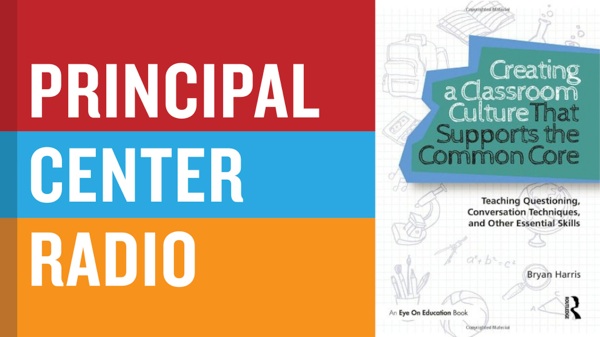
I'm your host, Justin Baeder, and I'm thrilled to be joined today by Dr. Brian Harris. Brian is the Director of Professional Development for the Casa Grande Elementary School District And most recently, the author of Creating a Classroom Culture that Supports the Common Core, Teaching Questioning, Conversation Techniques, and Other Essential Skills.
[00:36] Announcer:
And now, our feature presentation.
[00:38] Bryan Harris:
Brian, welcome to Principal Center Radio.
[00:40] Bryan Harris:
Thanks, Justin. I'm glad to be here.
[00:41] Bryan Harris:
So what was it that prompted you to write this book? What were you seeing in terms of what your students needed instructionally as in terms of new expectations from the Common Core? Talk to us a little bit about where this book came from.
[00:58] Bryan Harris:
Sure. Actually, I'll take you on a field trip back in our memory here for a little bit. Going all the way back to 2009, I was serving in the role I'm currently in as the Director of Professional Development. And I started hearing rumors about that time, some rumblings nationally about a national set of standards. Nobody really knew a lot about them at that time, but you started hearing more and more about it. And when I initially started learning about the Common Core and hearing about a national set of standards, I'll be quite honest with you, I was a bit reluctant.
[01:27]
I was a bit hesitant to the idea of a national set of standards. Initially, what went through my mind is, oh, no, here we go again. I had visions of NCLB floating around in my head of all these unintended consequences, and I thought, well, here are non-educators telling educators what to do. So I was a bit reluctant, but I soon found that it was just gaining more and more momentum. It wasn't going anywhere. So I dug in.
[01:50]
I started learning everything I could about the Common Core, attended webinars and read books and articles and just dove into them. And the more I learned about the Common Core, the more I became a big fan of the Common Core when I started learning exactly what the shifts are that are required of us as teachers. So although I started reluctantly, I ended up publishing that book you referenced. The Common Core is going to be a game changer. I think it's going to do great things for the expectations of the Common Core. And I'll get into what I see as some of the shifts here in just a minute.
[02:22] Bryan Harris:
So the book is Creating a Classroom Culture that Supports the Common Core. What are some of the key shifts that you see classrooms needing to make, things that we need to do differently as educators to help students meet the expectations of Common Core?
[02:37] Bryan Harris:
Sure. There have been a lot of discussions nationally about shifts and most of those shifts that you hear focus on content shifts. So a lot of anxiety actually in some of those discussions about perhaps some content that used to be fifth grade going down to third or some high school content going down to middle school or even some anxiety about certain books that were shown as exemplars. Now those shifts, they require our attention. We certainly should be talking about those. But from my perspective, the biggest shift that's required of us as educators is this balance between content knowledge and skills.
[03:13]
So the content knowledge, those are the things in the standards that students need to learn. And standards have always had content knowledge expectations. But the game changer as far as I see it is the shift, the balance between those content knowledge standards and the skills or what students are able to do with the content once they master it. So it's this balance. So the skills and the standards are the verbs. You'll see things like analyze, critique, evaluate, describe, explain.
[03:40]
that's the balance that the Common Core calls us to look at, is not only do students have to have content knowledge, that'll never go away, that's always going to be important, they have to be able to do something once they master the content, once they gain some knowledge, That's what they have to be able to do something with it. So that's one of the things I share in my writing and in my workshops. I talk a lot about the fact that our classrooms have to be organized for that balance. Traditionally, our classrooms have been designed primarily around the facilitation or delivery of content. That's always going to be important. That's never going to go away.
[04:14]
But the big question is, can students do anything with that content knowledge once they gain it?
[04:19] Bryan Harris:
Let's take a look at an example. What is one of the, say, questioning techniques that you present in the book?
[04:27] Bryan Harris:
Well, let me go back and I'll kind of give you one of the bigger ideas that I share in the book as well as in workshops. The title of the book is Creating a Classroom Culture. And that is, what are the things in a classroom that have to be kind of the basis so students can balance both content knowledge and skill development? And so one of the key features I share is this idea of risk. And so let's take the idea of analysis, for example. If students are going to get really good at analyzing something, that means they have to ask lots of questions.
[04:57]
They have to deal with divergent opinions. They have to talk a lot. They have to ask a lot of themselves cognitively. They have to be willing to take a risk to do all those things. They have to talk a lot. They have to ask lots of questions.
[05:09]
They have to challenge ideas. They have to deal with diverse opinions. In order to do these things in the classroom, I have to be willing to take a risk. But classrooms are traditionally not places that really promote much risk-taking. So we talk about in the classroom culture, risk has to be normal. And so I talk about four ways that you can help students develop this mentality of taking risks, risk actually being a good thing in the classroom, so that I can develop skills and deepen my content knowledge at the same time.
[05:37] Bryan Harris:
It seems to me that a lot of the anxiety around Common Core comes from not just the expectations that it places on students, but the new expectations that it places on teachers and the, you know, perhaps higher level of skill in facilitation and in questioning and in guiding class discussions. What are some of those shifts that you're seeing that require us as educators to kind of step up our game?
[06:04] Bryan Harris:
Sure. Well, let's talk about questioning. That's so essential. We've known the basic and the research behind the value of questioning. We've known that research for a real long time. Questioning involves helping students go a little bit deeper.
[06:20]
So when I talk with teachers, one of the best things you can do immediately to sharpen your own questioning skills is to pre-plan your questions. Don't rely on spur of the moment, don't rely on just your experience as a teacher, but consider the objective, consider the skill that you want students to develop, and then spend time pre-planning the specific questions that you're going to ask.
[06:42] Bryan Harris:
And that sounds like one of those things where Bloom's Taxonomy or the Depth of Knowledge could be a useful tool.
[06:48] Bryan Harris:
Absolutely. In fact, that's the basis. That's where you need to start at, at one of those tools in order to consider the needs of all the students in your classroom. One of my favorite quotes is, you know, if questioning is the vehicle for learning, then the questions we ask determines who goes along for the ride. And so as teachers, we need to give a lot of thought into the kinds of questions we're asking students because that's going to lead them cognitively to different places.
[07:14] Bryan Harris:
So when it comes to that issue of questioning and maybe asking questions that are at the deeper levels of Webb's depth of knowledge or Bloom's taxonomy, what are some of the missteps that you see people making or some of the misconceptions around those questioning and discussion techniques?
[07:32] Bryan Harris:
I think one of the things that some colleagues of ours, Douglas Fisher and Nancy Fry, they've written lots of books on questioning in the Common Core. One of the things they highlighted is the difference between quizzing and questioning. And I think that's real informative for us as educators, is a quiz, not an assessment quiz, but when we're interacting with students, a quiz interaction is one where you just ask them a short question. closed yes or no kind of question. For example, I think this is an example from Brian Fisher. You ask the question, what's a nocturnal animal?
[08:08]
And the student says an animal that stays awake at night. And you say, good, can you name an example of a nocturnal animal? And they say bat. Those are quizzes or just short little interactions with students. Based on that information alone, you can assume that the student knows all the characteristics and can perhaps even do well enough to pass a test. But there's a difference between a quiz, a short sample like that, and a true question.
[08:34]
Questions dig a little bit deeper. So in that same interaction, a teacher might say, what's a nocturnal animal? The student might say an animal that stays awake at night. So the question the teacher says then is, tell me more about that. Does a nocturnal animal have any special characteristics? And the student says, well, it doesn't sleep a lot.
[08:51]
And then you see, OK, this student doesn't quite know the information to the depth they need. So one of the things we tell teachers is understand that quizzes, those short little interactions, are important. But it's not until you dig deeper and start asking students to explain, to elaborate, to provide examples, that you really understand the depth of their knowledge, and then you can make decisions about how to change instruction. So one of the things you can do as a teacher, besides pre-planning your questions, is consider going a little bit deeper and asking more open-ended, deeper questions.
[09:24] Bryan Harris:
Well, and it seems like the second part of the subtitle of your book around conversation techniques could be a nice supplement to that.
[09:33] Bryan Harris:
Yeah, absolutely. Academic conversations are so essential. In order to develop those skills we talked about, the ability to analyze and critique and explain and clarify, students need to talk a lot. I've been asked over the years about how much student talk needs to be taking place in the classroom. And I struggle to give an exact number, 50%, 80%, because every classroom is different, right? Every grade level is different.
[10:02]
But our students seem to be talking a lot more. And I tell teachers this, the reason we know our content so well, the reason if I'm a middle school science teacher, the reason I know middle school science so well is because I talk about it all day. And I've been talking about it all day for years. And the ability to talk through your understanding, to make connections, to see other people's point of views, that helps deepen my knowledge. So we're really robbing our students of the ability to deeply understand things if we don't allow them to talk. In fact, if we don't encourage them and require them to talk a lot about their content.
[10:37] Bryan Harris:
So, Brian, in your role as a professional development director, you have the opportunity to see what it is that school leaders, that district leaders can do to help teachers develop these skills and put these practices in place in their classrooms. What's one thing that you would like every school leader to do to help students experience the kind of learning that you envision?
[10:59] Bryan Harris:
The first thing I think we need to do as school leaders is get better ourselves at asking questions, meaning we need to go into classrooms and do our best to suspend judgment until we get in there and start finding out what's going on. You know, certainly a 10-second walk by a classroom window, we don't have enough information to really make really good judgments. We need to get in there in classrooms, sit down with the kids, sit down with the teachers, and just ask them, how are you applying your knowledge? What are you learning? How are you critiquing? So if students are to develop those skills, we need to guide the questions we're asking of teachers and of students to get them to go a little bit more deeply.
[11:39]
Another thing I think that we need to do as teachers, besides getting in classrooms, asking lots of questions and diving into the life of the classroom and to the learning with the students, is to understand the difference between on-task behavior and truly cognitively engaged behavior. Because I can be on task but not engaged.
[11:58] Bryan Harris:
Right.
[11:59] Bryan Harris:
Big difference. Yeah, there's a big difference. And I think sometimes as leaders, we go by and we look at what's happening in classroom and we ask ourselves, are students on task? And if the answer is yes, then we're satisfied and we go on. but the task matters so for example i can sit in the classroom and listen to a lecture and perhaps take a few notes and maybe even have a couple of side conversations but really not be deeply cognitively emotionally engaged in the content you know as an analogy driving a car is a great great example right i can be on task driving my car but not engaged in driving my car and there's the danger in that right where I get sidetracked and and I have an accident you know at work I can be busy but not productive so as as educators I think we have those conversations with our teachers that yes I want on task behavior but what I want are really good tasks that truly engage students
[12:52] Bryan Harris:
Well, that's a great point about leadership in general, that we have to be careful what we ask for, because if we're asking for something that is kind of a proxy for or a substitute for the thing that we really want, then people are going to give us what we want, and we have to make sure we're asking for what it is that really matters.
[13:12] Bryan Harris:
And we certainly need control in our classrooms. We certainly need well-run classrooms. But sometimes we get so hung up, I think, as leaders on compliance behavior that we have to remember that sometimes critical thinking, some of these skills we want our students to develop, it has a tough time coexisting with compliant behavior. And so we have to help our teachers and ourselves understand that balance.
[13:38] Bryan Harris:
It seems that we have to create structures for it. We have to create opportunities for students to do that kind of thinking in a way that does move them along.
[13:47] Bryan Harris:
Yeah, indeed. In fact, in the book, I share lots of strategies. And again, the title is How to Create a Classroom Culture, because the idea is if my students are going to develop these skills, this ability to critically think and analyze and go deep and and really have rigorous experiences, then I have to create the culture that is the norm that we do those things. Right now in many classrooms, the norm is we complete our tasks, we do our work, we pass our assessments, and we go on to a new subject. I think the Common Core is calling us to change and balance that a little bit more. So we do fewer things, but we do them more deeply.
[14:23] Bryan Harris:
Well, Brian, thank you so much for sharing your thoughts with us about creating that kind of classroom culture. And the book, again, is Creating a Classroom Culture That Supports the Common Core, Teaching Questioning, Conversation Techniques, and Other Essential Skills, available from Eye on Education. And Brian, if people want to connect with you directly, where's the best place for them to find you online?
[14:45] Bryan Harris:
Sure. The easiest place is my website. It's www.brian-harris.com.
[14:55] Bryan Harris:
Fantastic. Well, Brian, thank you so much for taking the time to speak with us today.
[14:59] Bryan Harris:
You bet. I was glad to be able to spend some time with you.
[15:02] Bryan Harris:
And now, Justin Baeder on high-performance instructional leadership. So, high-performance instructional leaders, what were your takeaways from my interview with Brian? One thing that sticks with me is his statement that if you want to ask better questions, you have to think of them in advance. If you just go in and ask the first question that comes to mind, you're not going to get as good an answer as if you carefully plan your questions ahead of time. And I think this has a lot of implications for our work as instructional leaders. If we're coaching teachers and the first question out of our mouths is, so how did you think it went?
[15:34]
We're not going to get the same depth of response as we will if we have a more thoughtful and more better planned question. So when you're meeting with a teacher for a post-observation conference or just chatting after a walkthrough, if you come prepared with high-level questions that will prompt the kind of thinking that you want, you're going to see better results from those coaching interactions.
[15:56] Announcer:
Thanks for listening to Principal Center Radio. For more great episodes, subscribe on our website at principalcenter.com slash radio.